18 January 2015

A Lesson in Materialization Phenomena (with 21 documentary photos)

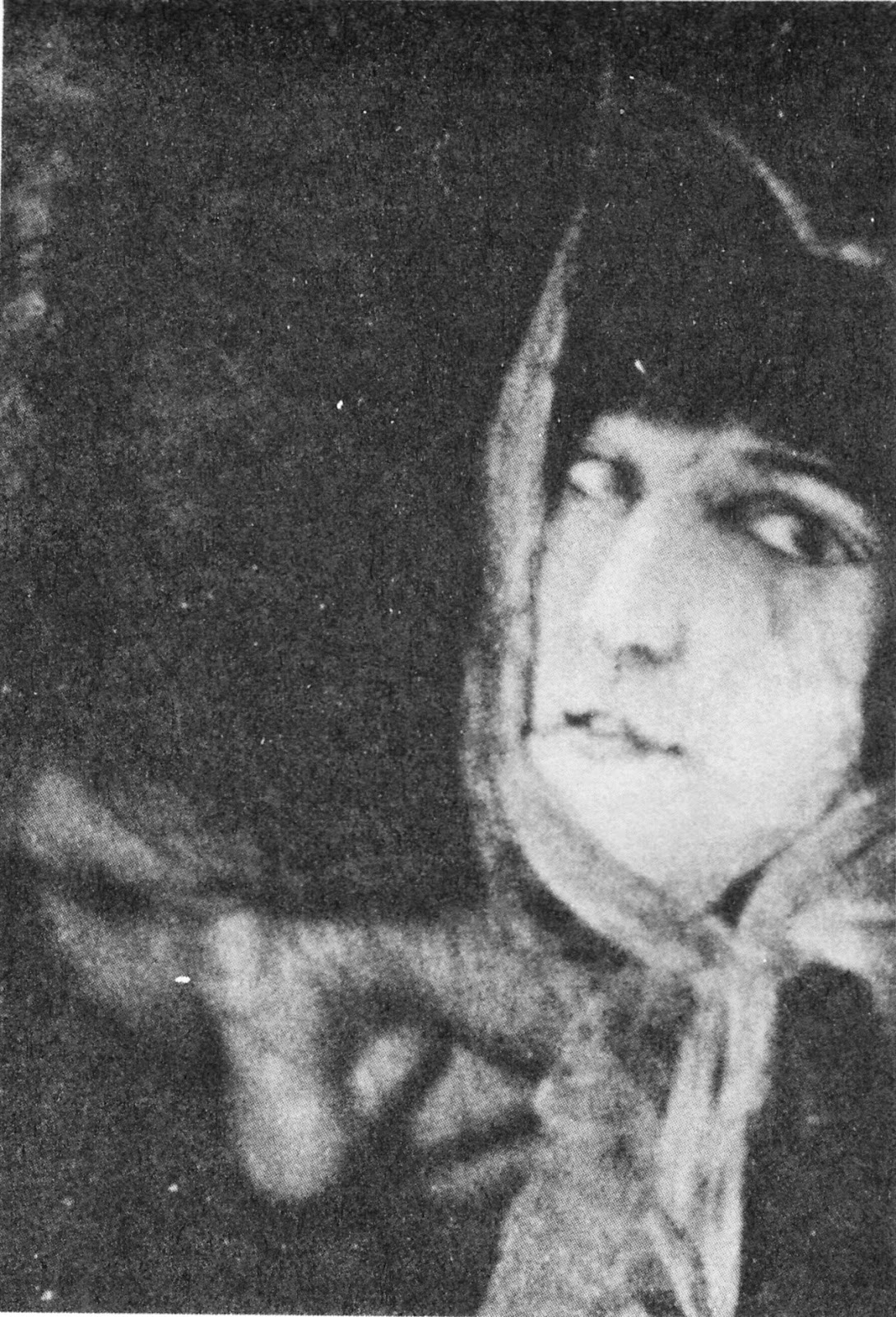
Clairvoyance and Materialisation (1927) is the English translation of L'Ectoplasmie et la Clairvoyance (1924) by Gustave Geley (1868-1924).  In the book, Geley described nine sittings with medium ‘Eva C.'  These laboratory notes are succinct so I am presenting them in this article with book photographs inserted when mentioned.  Some of the enlargement photos show the mobile and mutable aspects of the biological phenomenon involving the amorphous substance that has come to be called 'ectoplasm.'
 
Geley mentioned that medium Eva C. "exteriorises the amorphous solid in exceptional abundance."  It is more appropriate in what should be a more knowing epoch to qualify this statement by attributing the manifestations to an omnipresent Force.  Geley provided some background information about his investigation of Eva's mediumship. 

Mme. Bisson made Eva's acquaintance in 1909 and began to work with her.  From the outset she perceived that during the séances Eva's head and face were covered with a kind of white substance which transfigured her.  This was the beginning of further research.

The following year, Professor von Schrenck Notzing was introduced to the Bissons and began researching Eva’s mediumship with them.  Geley worked with Mme. Bisson from May 1916 to April 1918 at her house and for three months in his own laboratory (December 1917 to March 1918).  Thus he was able "to confirm without reserve the accuracy of the observations made by Mme. Bisson and Dr. von Schrenck-Notzing."  At the beginning of each sitting (or seance) Eva was hypnotized.  A 1918 lecture by Geley with observations about Eva was quoted in a supplementary article in Schrenck Notzing's Phenomena of Materialisation (1920) with Schrenk Notzing reporting: "Eva is brought, in the hypnotic state, to the stage in which she forgets her normal personality."

In Clairvoyance and Materialisation, Geley mentioned that Eva had shown clairvoyance as an aspect of her mediumship: "She has 'read' automatically on an imaginary screen, like that of a cinema, pages of philosophy . . . but during this period of her mediumship the ectoplasmic faculty disappeared."

The intentions of researchers to photograph the phenomena produced from Eva's mediumship may have been a factor that influenced aspects of materialization.  In the introduction of Clairvoyance and Materialisation, Geley commented that "the brighter the light, the more difficult it is to obtain phenomena . . . No doubt, by much patience and training of the medium, it is possible to operate in sufficient light.  Madame Bisson has been able to do this with Eva.  But as regards causes, the intensity of light and the perfection of materialisation are inversely proportional."

Geley reported about the experiments with Eva: "A bright and unexpected light perturbs the medium, but this effect of light is also very variable; in certain cases even daylight is endured.  The magnesium flash causes the medium to start violently, but the substance can stand it: this allows of instantaneous photography."
 
Manifesting forms attested by Geley as being of indisputable metapsychic origin included "imitations or simulacra of organs" such as fingers and "faces like masks, or as if cut out of paper, tufts of hair sticking to them, and undefinable forms."
 
The disappearance of materialised forms is as curious as their formation.  It is sometimes instantaneous, or almost instantaneous; in less than one second the thing that has been seen and touched simply disappears.  In other cases the disappearance takes place by degrees.  One can observe the return to the original substance and its resorption into the medium by the same changes as those of its development, but in inverse order.
 
Preceding Geley's laboratory notes (below) from the book are excerpts from Nandor Fodor's synopsis about Geley from Encyclopaedia of Psychic Science (1966). 

GELEY, Dr. GUSTAVE (1868-1924), distinguished modern psychical researcher.  In his first book, L'Etre Subconscient, published in 1899 in Paris, he expounded a theory of dynamo-psychism, a sort of soul energy by which he sought to escape from the trammels of materialistic philosophy.  In his second book, De L'Inconscient au Consient, 1919 (From the Unconscious to the Conscious) he developed this into a more comprehensive treatise and leaned to admitting an external direction and intention in the phenomena of trance which cannot be referred to the medium or to the experimenters.  Shortly before the publication of this work, which is considered by many as the most important contribution to psychical research since Myers' Human Personality, he abandoned his medical practice at Annecy and accepted, from Jean Meyer, the post of the director of the Institut Metapsychique International founded by Mr. Meyer.


His last book . . . was to have been followed by a second volume, The Genesis and Meaning of Metapsychic Phenomena, of which, however, the world was deprived by his sudden death in an aeroplane accident on July 15, 1924, a few days after a last seance with Kluski in Warsaw.
 
Experiment of January 11, 1918, at 5 p.m.

Present: Mme. Bisson, Mme. de Vesme, M. Le Cour, Dr. Geley.

Precautions: As usual, I controlled the left hand, Mme. Bisson the right.  Strong red light.

Nothing special to be noted unless that Eva had her period a few hours before.  Put to sleep, she soon fell into a trance, and almost at once the phenomena began.  It developed wholly under my eyes.

Her two hands were in full view, on her knees.  A membrane formed between her right and left thumbs, linking them together.  I could not see whether the ectoplasm proceeded from the right or the left or from both, her thumbs being in contact.  As soon as the extrusion began she parted her two hands, slowly and evenly.

The membrane lengthened and spread, as if it were of india-rubber, but, contrary to what would be the case with india-rubber, it thickened and grew as it extended.  I know of no fraudulent method of producing this.  The membrane soon formed a large thick cord, which under my eyes soon took the form of an epiploic fringe.

At this moment, without letting go Eva's hand, I started an electric flashlight, two cameras having been focused on her (Plate V., Fig. 22).
Fig. 22.—Exteriorisation of Substance from the Fingers: "Epiploic Form."


After the flash and the painful shock visibly produced on the medium, the phenomenon continued.

I saw in the midst of the ectoplasmic mass two fingers appear—index and medial—well formed with their nails, anatomically perfect.  Their colour was slightly bluish.  I touched them carefully.  They were colder than normal.  The fingers were living; they bent and extended.

While I was looking at them I saw them melt away in a moment, without apparent cause; only Eva's hand remained visible and sharply defined.  Total time occupied, fifteen minutes.

After about five minutes the fingers reappeared in the space between Eva's two hands, but this time without the accompaniment of any amorphous substance.  For the second time they disappeared instantaneously.  Then in the same space between the hands I saw an opaque mass about the size of a walnut, an indefinite form.

Eva moaned out, "It is a face!" but I could see nothing definite.  Again the ectoplasm disappeared, Eva not having moved.

She feels that "the powers are leaving her."  The experiment is at an end, having lasted an hour and a quarter.

Experiment of January 15, 1918, at 8:30 p.m.

Present: Mme. Bisson, M. Le Cour, Dr. Chalot, Dr. Mme. X., Dr. Geley.  Usual control and precautions.  The curtains remained half drawn.  Red light.  After fifteen minutes the moaning of the medium became characteristic.  Suddenly there appeared on Eva's left shoulder a white patch about 6 inches long and 4 inches wide, barely visible at first.  Its visibility increased, faded, and increased again, and it spread out.  I could see forming in the middle of the patch the features of a face about the size of an orange, surrounded by amorphous substance.  The face was flat and misshapen; only the forehead, the eyes, and the nose were recognizable; the lower part of the face was scarcely distinguishable from the matrix.

The form changed its position from the shoulder of Eva to the top of her head, slightly to the right.  Two photographs were taken, but unfortunately the electric flash was not bright enough for success.

After the second lash the phenomenon did not end by a reversal of the process of its formation and diminution of visibility; it was reabsorbed by the mouth.  I saw it slowly reabsorbed, seeming to open Eva's lips.  The lower part seemed to double up to enter the mouth.

A very curious and interesting thing then happened: a piece of the ectoplasm, about the size of a schilling, was detached, fell on the black garment, and instantly disappeared.

Experiment of February 7, 1918

I have said that the photographs taken on January 15 were failures.  The experiment of February 7 gave identical results.  I think it unnecessary to give a complete account of it, but this time the photograph was a success (Plate VI., Fig. 23).  It speaks for itself.
Fig. 23.—Genesis of a Face in a Mass of Ectoplasm.


Experiment of February 12, 1918, at 5 p.m.

Present: Mme. Bisson, Mme. de Vesme, M. Le Cour, Dr. Geley.  The usual control and precautions were taken.

Eva was very well disposed.  I note, merely as a fact, that on her arrival she said to me: "For the last twenty-four hours I have felt near me the presence of a woman who wished to manifest."

As soon as she "slept" she was affected, and moaned like a woman in labour.  Little by little she became calm without anything coming to pass.  I thought that the experiment would be a failure.  Suddenly Mme. Bisson exclaimed: "There it is . . . at the curtain."

It was so; above the medium's head, in the opening between the curtains and coming from the right, the head of a woman was visible at about the normal height of a person standing.  Only the head emerged from the curtain.  The materialisation was perfect; it was a living face of normal size, of fresh tint, and with expressive eyes.  The face was beautiful, and the experimenters gazed at it with expressions of admiration spoken in low tones.  I was so moved and surprised that I omitted to press the button for the flashlight.  I only thought of it when the apparition, doubtless inconvenienced by the light in the room or by our concentrated attention, retired behind the curtain.  This scene, though very clear, was very short—only a few seconds.

Then, during a quarter of an hour the same head appeared ad disappeared, sometimes of normal size, sometimes much smaller, but always sharply defined.  I could not hit on a favourable moment for the flash.

At last the head, reduced by two-thirds in size, placed itself on Eva's breast, in profile, and I pressed the button (Plate VII., Figs. 24 and 25).
Fig. 24.—Completely Materialised Face (Miniature). 
Fig. 25.—Same as 24, with a Second Camera Placed to One Side.
Fig. 26.—Enlargement of Fig. 25.


After the flash I saw the head for a moment on Eva's knees; I saw no shoulders.  Then everything disappeared instantaneously.

It is noteworthy that in this experiment I did not see any of the original ectoplasmic substance, nor the progressive formation of the head.  It appeared suddenly, completely materialised in the opening between the curtains.  The variations in the dimensions of the head, from natural size to much smaller, are also to be noted.

I am absolutely certain that Eva could not have brought (or carried away afterwards) the head of a doll or any other imitation.  This notion is negatived also by the changes of volume, which such a supposition could not account for.

Experiment of February 26, 1918, at 5. p.m.

Same persons present, and the usual precautions and control.

Eva very quickly passed under influence.  A materialised face developed round about the medium, disappearing and reappearing.  It had obvious resemblances to that photographed on February 12.

I remarked particularly that the manifestations seemed designed to show various modes in the genesis of the phenomena.

1. The face appeared at the curtain suddenly and without amorphous ectoplasm.  It was of natural size, but ephemeral, and immediately vanished, so that I had no time to photograph it.

2. The face was formed from a mist which floated at the side of the medium, then placed itself on her breast, her head, or her shoulder.  Its visibility increased and decreased alternately.  The features were not very marked.

3. A cord of substance issued from Eva's mouth, about two fingers' breadth.  It descended under her chin a little to the left.  At that point its end swelled like an expanding bud, and in this I saw the features of a face, not very distinct.  I pressed the button for the flash (Plate IX., Fig. 27).
Fig. 27.—Woman's Head in Process of Formation.  From a cordon of substance issuing from the mouth.


Despite a violent start of the medium, the flash did not cause the face to vanish.  The end of the ectoplasmic cord bearing the face mounted to the left side of Eva's head, floating about a quarter of a yard from the medium, a little higher than her ear.  There the features rapidly became more defined.  I then took a second photograph (Plates IX., X., and XI.; Figs. 28, 29, 30, 31).  Two stereoscopic photographs taken at the same time show that the face is three-dimensional, except in the lower part, which seems flat.
Fig. 28.—The same as Fig. 27, advanced One Stage, a Few Moments Later. 
Fig. 31.—Same as Fig. 30 [and same as 29, both enlargements of Fig. 28] (Greatly Enlarged).
The thick black hair which covers the head, of which a tress passes between the chin and the rudimentary substance, is not well apparent in the photograph.  On the other hand, the detail of the features is clearer.  Remark the impression and detail of the eyes, also the network of geometrical lines like a spider's web, probably indicating the mode of formation and lines of force; also the relation of the form to the rudiment and the organization of this latter.


Experiment of March 1, 1918

Same experimenters and same conditions.  The usual precautions and control.  On her arrival Eva said to me: "She wants to show herself differently than before, looking another way."

This sitting is almost the counterpart of the preceding one.  The apparition sometimes showed itself at the opening between the curtains, was sometimes condensed from a mist, and sometimes seemed to form at the end of an ectoplasmic cord issuing from Eva's mouth.

Four photographs were taken, of which two were failures through insufficiency of the electric flash.  On the less defective of these latter the same face [conjecture] as Fig. 25 can be distinguished, but, seen from the reverse side, it looks to the right of the medium instead of to her left.

(It is possible that this variation may be due to suggestion from the sitters, who wished to see the apparition from its other side.)

The two successful photographs also show a side face, inversely to the photographs taken at other séances (Plate XII., Fig. 32).
Fig. 32.—Woman's Head (Miniature).  The lower part of the face better materialised than the upper.


Experiment of March 5, 1918, at 5 p.m.

Present: Mme. Bisson, Mme. de Vesme, M. Jules Courtier, M. Le Cour, Dr. Geley.  Precautions and control as before.

After a quarter of an hour Eva begins to moan.  She says: "They take me differently . . . it is something different!"

I note these words cause us a lively disappointment, for we wished to see the beautiful face again.  Our desires therefore had no result, contrariwise to what we had thought at the previous experiment.

Eva's moaning increased, and I soon saw the ectoplasmic substance, dazzlingly white, issue from the fingers of her left hand and link them to those of her right hand.  She separated her hands, and everything went as on January 11.  The band spread, thickened and grew, and formed a large epiploic fringe.  The ectoplasmic mass mounted on Eva's chest up to her mouth, into which it disappeared.  Five minutes' wait.

Eva's moaning increased.  We then saw a mass of white substance exude from her nose and eyes.  It descended to her knees, thickening as it went, giving the impression of a fimbriated skein (Plate XIV., Fig. 34).
Fig. 34—Ectoplasm Issuing from the Facial Orifices.


The photograph was a good one (Plate XIII., Fig. 33).
Fig. 33—Woman's Head (Enlarged) Materialised at the Same Experiment as Fig. 32.  Notice the perfect formation of the lips and dark hair descending over the neck.


After a short time this fimbriated skein vanished instantly.  The substance then reappeared between her hands, and in it a very small hand; but the phenomena ceased almost at once, for the medium was exhausted.  Resorption into the fingers was instantaneous.

Experiment of March 8, 1918, at 5 p.m.

Present: Inspector-General Calmette, Mme. Bisson, Mme. de Vesme, M. Le Cour, Dr. Geley.  The usual precautions and control.

After an hour's wait Eva began her moaning, which became more pronounced.  A white spot appeared on her left shoulder.  This spread and thickened, and in the middle of it we could see a small face like that of previous sittings.  At the same time the greater part of the amorphous substance disappeared; only a small mass was perceptible, which moved to Eva's chest and there remain fixed as by a kind of stalk proceeding from the right side of the mouth of materialised face (Plate XIV., Figs. 34, 35).
Fig. 35.—Woman's Head, with a Kind of Embryonic Body in a Mass of Substance Ending at the Corner of the Materialised Mouth.


This constituted, the face developed, moved from place to place, disappeared and reappeared; it was seen on Eva's chest, by the side of her head, under her chin, on her knees, and between her hands.

It disappeared, whether instantaneously or by resorption, into the mouth.

After a while I saw the right-hand curtain of the cabinet shake as if moved from inside.  At this time Eva was motionless on her chair and could be seen in the space between the half-drawn curtains.  Her hands were on her knees, and I was holding her right hand.

Seeing that the movements of the curtain could not be caused by the medium, I felt round with my left hand.

I could clearly feel a human body, which was shaking the curtain.  It seemed of normal size; I felt the shoulder, and, lowering my hand, I felt the thorax and reached to the level of the pelvis.  At this moment a hand inside the curtain pushed my hand back, and a moment later a head appeared at the opening of the curtains (Plate XV., Fig. 36).
Fig. 36.—Same as Fig. 35 photographed a Moment Later.  The face was above and to the right of the medium in the opening between the curtains.


Mme. Bisson declared that she was touched on the neck and shoulder by a hand, through the curtain.

I distinctly state that throughout these phenomena Eva was completely visible.  Her head and bust were always in view, her hands held and resting motionless on her knees.

Experiment of March 11, 1918, at 5 p.m.

Present: Dr. Calmettte, Mme. Busson, Mme. de Vesme, M. Le Cour, Dr. Geley.  Usual precautions and control.

During the whole of this experiment the curtain remained half open, and I could observe the entire genesis of the phenomena.

After waiting three-quarters of an hour the trance began.  I saw a small mist, about the size of a large orange, floating on the medium's left; it went to Eva's chest, high up and on the right side.  It was at first a vaporous spot, not very clear.  The spot grew slowly, spread, and thickened.  Its visibility increased, diminished, and increased again.  Then, under direct observation, we saw the features and the reliefs of a small face growing.  It soon became a well-formed head surrounded by a kind of white veil.  This head resembled that of preceding experiments.  It often moved about; I saw it to the right, to the left, above and below Eva's head, on her knees, and between her hands.  It appeared and disappeared suddenly several times.  Finally it was resorbed into her mouth.  Eva then cried out: "It changes.  It is the power!"

The sitters then felt blows through the curtain.  (Eva's hands and knees were in sight and held.)

During this experiment I took several photographs, all successful (Plates XVI. to XX., Figs. 37 to 44).
Fig. 37.—Woman's Head forming Round the Medium. 
Fig. 38.—Same as Fig. 37, a Moment Later. 
Fig. 39.—The Same in Another Position. 
Fig. 40.—The Same Slightly Masked by the Intervening Head of One of the Experimenters.
Fig. 41.—The Same, in Process of Dematerialisation.  Resorption by the medium's mouth. 
Fig. 42.—Same Head in Another Position (Enlarged).
Fig. 43.—Enlargement of Fig. 40.
Fig. 44.—Enlargement of Fig. 38.
 
Geley's Introduction for Clairvoyance and Materialisation includes commentary about how misunderstandings have occurred about mediumship, such as the actions of mediums in an altered state of consciousness being misinterpreted.  Geley also commented that "the strange aspect of the ectoplasmic substance . . . may assume the likeness of more or less visible filaments, giving an unaccustomed observer the impression of threads intended to move an object fraudulently.  At other times it assumes the appearance of light woven stuff like muslin, and photography shows the web.  This has often been thought a proof of fraud in cases of quite genuine metapsychic phenomena."

Ectoplasmic organs are often flat, irregular, and incompletely formed.  As I shall show when dealing with defective materialisations, these imperfections not only do not prove fraud, but attest the honesty of the medium.


. . . the perfection of materialised organs may cause the same illusion.  Inexperienced observers see a perfectly formed and living hand move some object; their first impression is naturally that it is the hand of the medium.


14 January 2015

Asset Pricing Mooc

The new and improved online version of my PhD class "Asset Pricing Part 1" will open for business January 18.

You can learn more about the class and sign up for it on the Coursera website here. (Part 2, which follows this spring is here. Part 1 and 2 will be completely separate Coursera classes, so take what you want.)

The videos and quizzes have been useful for people who are not "taking" the class, or as supplementary materials for people teaching regular classes. I taught my PhD class by asking the students to watch the videos before coming to class, which allowed a higher level discussion. Feel free to use these resources any way you wish!

While we're at it, I maintain a section of my research website with extra materials for people using the Asset Pricing book in classes, here, and my teaching materials from MBA and PhD classes are here

To whet your appetite, here is the syllabus from the two classes.

Part 1 syllabus:
  • Week 1: Stochastic Calculus Introduction and Review. dz, dt and all that. 
  • Week 2: Introduction and Overview. Challenging Facts and Basic Consumption-Based Model. 
  • Week 3:
    • Classic issues in Finance
    • Equilibrium, Contingent Claims, Risk-Neutral Probabilities.
  • Week 4: State-Space Representation, Risk Sharing, Aggregation, Existence of a Discount Factor.
  • Week 5: Mean-Variance Frontier, Beta Representations, Conditioning Information. 
  • Week 6: Factor Pricing Models -- CAPM, ICAPM and APT. 
  • Week 7: Econometrics of Asset Pricing and GMM.  
  • Final Exam
Part 2 syllabus: 
  • Week 1: Factor pricing models in action
    • The Fama and French model
    • Fund and performance evaluation.
  • Week 2: Time series predictability, volatilty and bubbles.
  • Week 3: Equity premium, macroeconomics and asset pricing.
  • Week 4: Option Pricing.
  • Week 5: Term structure models and facts.
  • Week 6: Portfolio Theory.
  • Final Exam

12 January 2015

Phenomena of Materialization

Phenomena of Materialisation was published in London and New York in 1920.  The book is the English translation of Baron Albert Von Schrenck Notzing’s Materialisations-Phaenomene (1914) case study of personally witnessed and documented mediumistic phenomena.  The original German edition was expanded for the English translation to include supplementary work and subsidiary material accumulated since Schrenck Notzing's research was first made public.  This review article presents some of the details from the in-depth notes and records of sittings presented in the book.  Addressing "On Method in Mediumistic Investigations," Shrenck Notzing wrote:

The author of this work, who has occupied himself more than twenty-five years with this subject, has had opportunities of observing mediums of all shades, both professional and private.  In conjunction with other savants he has had [formerly] occasion to reduce a whole spiritistic epidemic to its fraudulent causes (superstition and fanaticism) by means of careful and detailed investigations.

The medium was known as ‘Eva C.’  Schrenck Notzing’s recorded observations spanned four years with the medium being hypnotized during the sittings, all which "took place in a red light, so that during the four years there was not a single entirely dark séance.  We began with a single lamp and ended with a six-lamp chandelier of more than one hundred candle-power . . . We began with a single camera, but at the end of the fourth year we sometimes had nine cameras, including several stereoscopic cameras, in action at the same time."  From one to three cameras were mounted in close proximity to the medium, who sat in a portion of the room known as the "cabinet" behind heavy curtains that would be opened and closed.  The book has more than two hundred photos including enlargements.

Both for the materials for the furnishing of the cabinet, as well as for the dress of the medium (for which knitted fabrics are preferable), a black colour is to be recommended.  For with a black background even the finest, hardly visible materialised fabrics can be seen.

The informal guardian of Eva during this period was Mme. Bisson, the wife of a prominent French playwright. 

Eva C. is not a professional medium, i.e., she is not obliged to engage herself for sittings for money, but can return at any moment to her parents and sisters.  But she prefers her independence and lends her remarkable power freely to Mme. Bisson and her collaborators for scientific purposes, from gratitude for the years of hospitality enjoyed in the house of the Bisson family.

The records of the author’s observations of with Eva C. were written down after each sitting and in the last six moths even during the sittings themselves.  Alexandre Bisson had been "induced by the phenomena observed in the case of Eusapia Paladino to collect further experiences on the subject of mediumship."  The desire of the Bissons was "to serve truth without any preconceived opinion" among a circle of friends of "sober-minded observers . . . the arrangement of the experiments was directed towards the elimination of fraudulent manipulations and self-deception.  Hence, at each sitting: complete undressing of the medium, strict examination of the cabinet, use of photography."

In the book's Introduction, Schrenck Notzing divided the "most objective performances of mediumship" into two main groups: 1. 'Telekinetic Phenomena' comprising of "every sort of action upon inanimate objects without [visible] contact"; and 2. 'Teleplastic Phenomena' including "materialisation phenomena . . . the production of forms and materials  of organic or even inorganic matter . . ." 

After citing some of the recent technological advances of the epoch, he wrote:

Another important advance is the abandonment of the materialistic conception of the universe which, even thirty years ago, was in sole possession.  Modern physics regards matter as a form of motion, and is dominated by the idea of energy.  Psychology also is gradually emancipating itself from the purely physiological conception of mental life; and under the leadership of the philosopher Bergson, it tends to acknowledge the superiority of the psychical over the physical.
 
Schrenck Notzing—a practising physician from Munich—was introduced into the Bissons’ Paris circle by one of the participants.  Eva had come to Paris in 1908 after leaving school at the age of seventeen and a half.  In a lengthy report about her health and psychology there was nothing explicitly unusual.  "Her mediumistic gifts were discovered by accident when a relative operated in her presence with another test person.  In her family circle spiritualistic sittings were held with Eva C. four or five years before the beginning of the Paris experiments."  She was identified as Marthe Béraud by Charles Richet in a 1922 book translated from the French as Thirty Years of Psychical Research (1923).  Schrenck Notzing commented: "Since the author is not justified in publishing details concerning her personal and family affairs, he need only mention here that although Eva C. has an unfavourable heredity, she has not passed through any serious illness.  The relatives of the girl are all in respectable situations in industry, or the Civil Service."

Schrenck Notzing wrote about Eva:

She has a great faculty of adaptation to persons, and one might compare her relation to Mme. Bisson with that of a faithful dog to its master.  But, in these circumstances, one can understand that Mme. Bisson cannot surrender her medium into other hands for the sake of experiments, since Eva would be equally accessible to the new influences as soon as she was accustomed to them.


After Eva C. had, during the first period of her mediumistic activity in the Bissons’ house (from February 1909), lived outside, she was received into the family in the autumn of 1910, and lived at first in the studio flat of Mme. Bisson, who was occupied with sculpture.  When the latter moved to a new place, after the death of her husband in the spring of 1912, Eva was given a room in the new flat.  From the moment of her reception into the family she was always treated as one of the family, though she was constantly controlled.

Schrenck Notzing reported that during the four years of researching Eva's mediumship fifty-four percent of the sittings overall were without result.  In Eva’s presence there were observed "no raps, no table-tiltings, no ‘apports,’ no telekinetic phenomena" but there was continuously seen "the production of materially formed bodies, beginning in barely visible and optically cloud-like or amorphous structures, and ending in the formation of solid materials, or organic shapes."

Schrenck Notzing reported, "As a rule, the medium had no subsequent recollection of her trance condition."  When Eva’s hands became hot, this was found to be an indication that there would be no further phenomena seen.  Before sittings, if Eva was restless and complained of palpitation, this was "a sign that we could expect a favourable sitting."  Schrenck Notzing noted occasions when Eva vomited blood and in consideration of the malady she was examined at the Antoine Hospital.  Sittings described in the book span from May 21, 1909 through July 23, 1913.

The photographing of the medium with a flashing light during seances began with a mishap.  Fig. 1 was what was recorded when —

The flash-light was ignited, but, at the same moment, the paper cylinder caught fire, and it appeared as if the flames would spread.  A panic took place among the audience, some of the ladies screamed with fright, and fled. But we succeeded in extinguishing the fire.

Shrenck-Notzing reported: "With a cry of pain the medium sank back into the chair gasping convulsively . . . The medium had fainted, and lay in the chair bleeding from the nose, and the sitting had to be closed.  I slowly wakened Eva by suggestion."
Fig. 1. Photograph by Mons. André Bisson (son) on November 25, 1909.


In his description for the sittings of October and November 1910, Schrenck Notzing provided more details about the lighting.  Ceiling lamps were contained in ruby glass globes.

The red light permitted us to leave the camera open as long as necessary during the sittings.

The slides with the plates (manufactured by Hauff & Lumière) I put into the camera myself before each sitting, and I removed them myself afterwards.


The electric ignition . . . turned out to be the most reliable when it was connected with the lighting supply by means of a plug adapter.  A pressure switch held in the hand, with flexible cord attached, allowed of a quicker action of the apparatus than the previous arrangements.  Afterwards the optical impression could be compared with the photographic result.  As soon as a photograph was to be taken, those present withdrew from the opening of the curtain, in order not to obstruct the picture.
 
Schrenck Notzing mentioned in his commentary about a May 1911 sitting that "As soon as a partial awakening from the deep sleep occurs, and a stage of active somnambulism sets in, in which the second personality dominates Eva’s reduced consciousness, mediumistic performances may be expected."  He noted this to be an individual peculiarity and not common to all mediums. 

During the phenomena there is always a spiritual connection of the medium with those present, even when the medium appears sunk in a passive lethargy and quite taken up with the act of production.  But, as a rule, she takes part in the conversation of those present, puts in remarks or instructions, and sometimes asks questions, e.g., whether the developing creation is already visible to us.

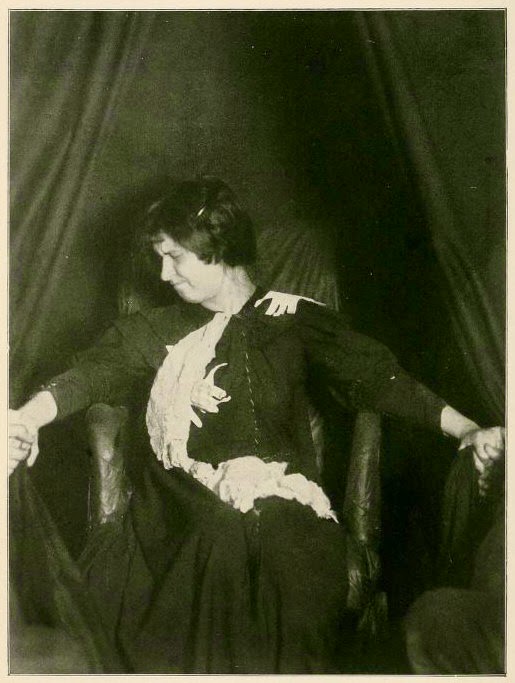
The predicament that soon confronted Schrenck Notzing upon consideration of the photos was addressed in his commentary from March and April 1911.  The photograph presented as Fig. 27 was realized as likely to result with a person having no knowledge of the circumstances making an erroneous judgment about the teleplastic projection that formed into what appeared like 'a white paper glove' on the medium's shoulder.
Fig. 27. Flashlight photograph by the author, March 13, 1911.
(Below) Fig. 29. Flashlight photograph by Mon. De Fontenay at sitting of April 18, 1911.
Fig. 29 is described as being remarkable for showing the anomalous material "being thick, soft and yielding at the top, like a woolen material, while the two extremities, hanging down, give the appearance of a thin, sharply bordered, flat structure, resembling paper."

If the teleplasm can undergo such changes, the picture may be regarded as an instructive preparation for the flat, sharply bordered materials, resembling paper, occuring so often at later sittings, as, for instance, in the portraits of heads.

Schrenck Notzing wrote that Fig. 33 shows "the material radiating from the top of the medium's head . . . Eva sits with head bent forward in the cabinet."'
Fig. 33.  Flashlight photograph by M. De Fontenay, June 10, 1911.
 
 
In the section of his book "Psychical Phenomena" following the description of the last sitting at the residence on Avenue Victor Hugo, Schrenck Notzing described some of the different aspects to consider about the case.

. . . the psychical personality of the somnambulist differs from that of the medium in the waking condition.  The latter is rather indifferent to the results of the sittings, but gladly occupies herself with feminine problems—the cut of a new dress, a new hat, some amusement, a harmless flirtation, a compliment on her looks, can engage her whole interest, change her emotional state, and influence her course of action.  To these were added, at irregular intervals, fitful lapses of temper, not warranted by external conditions, spells of anger, under the influence of which she sometimes lost her self-control and plied those about her with unfounded accusations.


. . . while Eva, with closed eyes, and without any apparent participation, leant her head against Mme. Bisson’s shoulder, and appeared quite unable to control the composition of letters [on the 'table of letters'] by her right hand, or to read what she had automatically written.  Mme. Bisson, even, could hardly keep pace in noting down the letters, and, in any case, during this operation she did not appreciate the sense of what was being written.  The subsequent study showed messages giving a connected sense, usually referring to a sitting, and giving explanations and instructions as to how to treat the medium.

"Berthe" presents a self-contained psychological existence elaborated in detail.  Whether she manifests through Eva psychically or physically, in both cases her action is relatively less trying for the medium than the manifestations of her other personifications, especially male ones.  She also expresses herself, though more rarely, directly through the mouth of the somnambulist, and addresses her as a third person, so that Eva repeats verbatim what "Berthe" communicates to her.


On several occasions, during the observation of Eva’s somnambulic inspiration, Mme. Bisson observed a "lucid" moment, in which apposite remarks were made concerning occurrences beyond the range of knowledge of the medium.  In some cases these also referred to future events.  I ought to remark that the whole material of observation was entered, after every sitting, by Mme. Bisson in a note-book, which allowed of an accurate verification afterwards.


Shortly after the death of M. Bisson a new psychical entity manifested itself through Eva in the trance state.  It came into play in a very sudden manner, and in apparent conflict with the medium, with violent defensive motions and convulsive muscular contractions.  This personification called itself "Alexandre Bisson."  It spoke through the mouth of the medium, with a deep voice.  It only remained for a short time, and caused profound bodily exhaustion to the medium.  I myself have never seen this "incarnation," and only know of it through the reports of my collaborator, who, after thirty years of happy marriage, would know her husband better and more exactly than any other person.  Indeed, according to her report, the personification "Bisson" commanded the memory, the language, the mode of expression, and the character of her dead husband.  Mme. Bisson was convinced that she was in the presence of the psychic existence of her husband.  She repeatedly asked him questions which he alone could answer, and his answers were always correct.  M. Bisson, when alive, stammered, especially when in a state of excitement, and this stammering occurred in the conversation.

The communications of the type "Bisson" referred to his family life, to the completion of a drama left unfinished, and to our sittings. "Bisson" said we were on the right way, and should not allow ourselves to be discouraged by anything from continuing with the investigations.
 
Schrenck Notzing’s case record did not include many statements made by the manifesting ‘personifications.’  One male personification was known by the name ‘Dorsmica.’  A repeating female visage was called ‘Estelle.’  In a letter dated December 18, 1911, Mme. Bisson wrote, "After the entity ‘la petite Estelle’ had shown itself several times, a male face appeared, and three times I clearly recognised my deceased nephew.  The apparition disappeared slowly, being wafted upwards.  Then the medium said, 'I see nothing more, nothing at all.'"
This is one of the seance room diagrams shown in the book.


Here are some excerpts from Schrenck Notzing’s accounts of sittings to provide examples of the proceedings.
 

From "Sitting of the 22nd October 1910."

Once I saw a greyish white cloudy column proceeding from her left upper arm, and, later, from her right upper arm.  It was about 20 inches long and 2 or 3 inches thick, and at the upper end there was the form of a small female hand, endowed with a motion of its own, and with its broad side towards us.  This hand executed graceful and beckoning motions, while the vapour column moved to and from, as if keeping time with it.
 
Both the medium's hands lay quietly before us on her knees, fully illumined by the red light.  Her head reclined on the back of the chair.  The same phenomenon was repeated on the right-hand side.  We could not see whether the palm or the back of the hand-shaped body was turned towards us, neither could we see any details in the design of the hand.
 

The same shape also appeared to execute beating and waving motions with something resembling a strip of muslin.  The strip in the course of its movement, became visible in front of the medium, and on one occasion touched my face.
 
I also perceived a white patch in her lap resembling a strip of muslin bunched up.  This disappeared rapidly without any perceptible aid from her hand.  For the first time the author could, during this sitting, witness attempts at the formation of heads.  But the optical impressions described in what follows were so swift, lasting barely a second, that the recognition of details appeared hardly possible, in spite of the closest attention.  In this and the following sittings the forms resembling heads were shown mostly near the curtain on the medium's left, i.e., in front of the medium, about 30 inches away from her head, and at the level of the head of a man of medium height standing upright.  At first they were only fragments of heads, and partial formations, in which certain lines and forms, resembling faces, could be clearly recognized, while the rest appeared to be a dark undeveloped mass.  Thus, I saw in this sitting a face looking upwards, in which I could recognize the bridge of the nose, the forehead, the hair and a rough outline of the head.  A broad band surrounded the forehead.  Owing to the fugitiveness of the impression, eyes and other details could not be recognized.  The medium, of course, remained visibly seated on her chair during these phenomena.
 

Since the curtain seemed to be inflated on Eva's left side, I again inserted my head in the cabinet.  To my greatest astonishment I then saw, on my right, behind the curtain, and as far as I could see suspended in mid-air, a completely developed female bust, with its head, neck and breast completely swathed in veils.  This was at the height of a person standing upright, while on my left, tangible and fully illuminated, the medium's whole body lay stretched in the chair.  The features of the apparition could not be recognized on account of the veiling.  This appearance lasted about four seconds, and was clear, beyond all doubt, and most convincing.
 
From "Sitting of the 28th October 1910."

Eva had, in the hypnotic trance, given Mme. Bisson on the previous day detailed instructions how to treat her after the flash-light photographs, which always produced a severe nervous shock.  She demanded an instant closing of the curtain, the silence of the spectators and a period of rest.  On carrying out these instructions the present sitting was continued with success.

 
In the semi-somnolent or somnambulic state, there is a close mental rapport with all those present, and particularly with Mme. Bisson, for whom Eva feels a close friendship.  During the sitting she carries on a conversation with her protectress, tries to read her innermost soul, asks again and again whether her protectress is not tried, and whether she can see her creations, whether any ideas are preoccupying her; in short, she gauges with a correct instinct the psychological state of the sitters, often intervenes in their conversation, and corrects erroneous interpretations, but shows great delicacy in avoiding saying anything which might be disagreeable to those present.

From "Sitting of the 30th December 1911."  (conducted at the villa at St. Jean de Luz near Biarritz)

Immediately after the extinction of the white light and the setting-in of the somnambulic state, Eva made the well-known noises of long-drawn expirations and stertorous groaning and gasping.  Hardly had I taken my place to the medium’s right, when a white mass, double the size of a hand, became visible in her lap.  During the following twenty minutes the psychophysical efforts continued.  The substance changed its place, and at the next exposure we saw it on Eva’s head.  I requested her to show the female face previously photographed, which, according to the medium, belongs to an entity "Estelle," and this was promised.  Also, the head was to be visible in a larger size than before.

After another ten minutes the curtain opened again, and I saw attached to Eva’s head, on the right side, a female face in profile, swathed like a nun.  The bandage went over the forehead and covered the ears, but the image was only visible a moment in the light.  When next the curtains were open the head stood a little lower, about the level of her chest, 20 inches above her right hand.  I then saw the same pretty female face quite distinctly . . .
Fig. 60. Flashlight photograph by the author, December 30, 1911.
 
 
Beginning in May 1912, sittings were conducted at a new residence at Rue George Sand 33 in Paris.
 

From "Sitting of the 1st June 1912."
 
On this day Mme. Bisson hypnotised the medium at 5 p.m. in preparation for the evening’s sitting.  The personification calling herself "Berthe"—the controlling spirit in the spiritistic sense—announced through the somnambulist’s mouth extraordinary phenomena for to-day’s sitting.  "Berthe" would endeavour to show us the head of a person closely related to us, and would, if possible, appear simultaneously.  She would see if we would recognise her.

Before the sitting Eva had a dreamy and dazed expression, and already showed a quickened pulse two hours beforehand. 


Illumination with red light, aggregating about one hundred candle-power.

Eva had hardly been hypnotised on her chair by Mme. Bisson when she breathed loudly and stertorously, with every sign of deep trance.  The teleplastic creative process commenced at once.  At the place in the curtain which had been made familiar by practice, and in which the phenomena had shown themselves at the last sittings, i.e., on the inside of the left curtain, at about the level of the medium’s head, a white luminosity, as of a strip of muslin 20 inches long, became visible.  Eva then tried gradually to expose the image to the light by rolling up the left curtain flap with her left hand, and thus gradually allowing the red light to fall upon the object, obviously fixed inside.

To my greatest astonishment I seemed to recognise in the masculine face, shown with the well-known drapery of veiling, but sketched as with black chalk on a flat surface, the features of Alexandre Bisson, the husband of my collaborator, who had died in January 1912.


The pictures (Figs. 90, 91, 92 and 93) recall face-masks artistically exposed with clever veil drapery, but without any signs of real life, in spite of the greatest portrait resemblance.  Besides, no plastic development of the features could be established with any certainty either in the sittings or from the photographs, while the base of the pictures appears to me to resemble paper.  The transition towards the pictorial representation of the face proceeded in stages, since in the beginning, as in previous sittings, the only thing to be seen was material in rather large veils and fragments, with which Eva would sometimes cover her own face.
Fig 90 and 91. Author’s flashlight photograph of June 1, 1912 (second series), On the right: enlargement.
 
In spite of the three flash-light exposures, the phenomena continued.  The structure now appeared on the left shoulder.  Eva illuminated it first with the red and then with the white electric torch, but the image, in which I distinctly perceived a male bearded face, with a high forehead, would not suffer the light, and disappeared behind the back of Eva's chair towards the back of the cabinet, without Eva having changed the position of her hands.  Since I had closely followed the image from the shoulder, I did not let it go out of sight, but rose and put my head deep into the cabinet, bending over Eva as she sat quietly, and keeping the curtain closed under my chin.  In this way a ray of light passed over my head, through the top of the curtain, on to the back of the cabinet, without disturbing the medium.  The male face then stood facing me like a male portrait in life-size, fixed on the back wall, remained for about six seconds, and then revolved about its own axis flat on the wall, the upper part of the face falling down, and finally disappeared towards the floor behind the medium's back.  During this whole observation Eva's body was motionless, and under my observation.  The image was entirely separated from her.  Its motion and disappearance appeared to be under the control of an unseen power.
  
Thus ended this extremely remarkable sitting, during which Mme. Bisson had not entered the cabinet at all.

Schrenck Notzing reported that while Eva knew M. Bisson when he was about sixty, the portrait corresponds to his appearance at the age of thirty-eight.

There were more sittings with Eva C. in late 1913/early1914 (Paris) as Schrenck Notzing explained in one of the supplementary chapters of the book: "The criticisms and attacks following upon the publication of the German and French editions of our records induced us to make new experiments with Eva C. as a further test of the objections raised."  The following is the description for one of these sittings.
 

From "Sitting of the 8th December 1913." 
 
Present.—Dr Bourbon, Mme. Bisson, and the author.

All conditions as in previous sittings.

6.5 p.m.  Hypnotisation.  The curtain remained open from the beginning of the sitting.  The hands were constantly visible and under control, and were not withdrawn for an instant.


6:55 p.m.  We see a life-sized male head on her breast, covering it entirely.  It gives the impression of a strong pictorial representation on a skin-like basis.  The full beard is especially clear.  The head resembles that of the whole phantom [as photographed upon materializing at four previous sittings].  It disappears before our eyes while the curtain is open, without being absorbed by the mouth, and again as if its luminosity had ceased.  The hands did not move during the occurrence, and Eva's head also remained motionless.  The drawing of the face was black on a white ground.

7.5 p.m.  Close of the sitting.  Final examinations negative.

A few days before the author's return, on the 7th January, Mme. Bisson, in a sitting alone with Eva, again observed the phantom seen by the author on 8th December.  She turned on the red light and then ignited the magnesium apparatus.  In this experiment, also, the medium's hands were always visible and excluded from participation.  The photographic result (Fig. 198) completely corroborates the author's observation of the 8th December 1913.
Fig. 198.  Mme. Bisson's photograph of January 7, 1914.


The November 27, 1912 sitting resulted with a photo offering a side view of the medium’s head.  Just behind her on the left side, a word in small type "Le" and a word below this in large type "MIRO" can be recognized.  Schrenck Notzing commented, "That is evidently meant to be ‘Le Miroir.’  We can just recognise the top of an ‘I’ following the ‘O,’ but the next ‘R’ is covered.  I cannot form any opinion on this curious result."  This photographic message became significant as following photos of head images seen at sittings were eventually claimed by skeptics to have derived from similar images in the journal Le Miroir.  Some of the supplementary chapters of the book refute the simplistic and erroneous explanations offered by denialist accusations concerning the evidence.  Schrenck Notzing observed: "It seems, in the first instance, to be faulty logic to derive a proof of fraud from the constitution of the materialised object, since there is always the possibility that such apparently suspicious substances may be produced by the medium under conditions excluding all fraud."  Shrenck Notzing identified the discrepancies between the phenomenal images recorded in seance photographs and comparable images of mundane items such as the newspaper title logo. 
Fig. 119. Side view (enlarged) of Fig. 118 taken within the cabinet.
 
 
Schrenck Notzing wrote about what happened during the following sitting of November 29, 1972.  After being hypnotised by Mme. Bisson at 9:30 p.m., "Hardly had she gone into hypnosis when she said the word "Miroir."  Her following words translated to English are: "She (Berthe) wanted to write to you the other day.  She wanted to send you her written thought.  You are her mirror.  She sees herself here.  You have a photograph of the thought of Berthe.  She has the joy of creating another image for herself."
Fig. 120.  Author's Flashlight Photograph of November 30, 1912.
Fig. 121 (Inset).  Side view of Fig. 120.


Concerning Fig. 120 and Fig. 121, images are seen with different characteristics from the different angles.

Schrenck Notzing’s book also includes photographs of teleplasm photographed during sittings with other mediums, including ‘Stanislava P.’ 
Fig. 170. (Stanislava P.) Author’s Flashlight Photographs, January 25, 1913.


In "Result of the Observations," Schrenck Notzing quoted Editor of the Annales des Sciences Psychiques C. de Vesme, whose observations and impressions of his sittings with Eva C. fully corroborate those of the author: "The  impression produced on those who do not attend the sittings is mostly unfavourable.  Why? . . . Their attention concentrates itself chiefly upon those photographs, which create some suspicion . . ."
 
Schrenck Notzing referred to his arguments used in discussing the phenomena of Linda Gazerra to argue against rejecting any phenomenon on the basis of only the assumption of fraud —
 
"The unknown force, of a possibly psychic origin, as soon as it wishes to present or materialize things for our senses, uses a picture language known to us in order to be at all intelligible."


"The suspicious appearance of a mediumistic photograph is not sufficient proof of production by fraudulent manoeuvres, and, generally speaking, the whole use of the photographic art has no significance except in conjunction with an accurate record of the experimental conditions."
 
Schrenck Notzing reported that there were people whose response to the publication of his book and evidence was to denounce his investigations as fraud.  He in turn commented:

A careful examination of the objections and arguments brought forward by our opponents has shown their baselessness.


We must also protest against entirely baseless rumours, reports of detective bureaus, or low gossip (Richet case, Algiers) being presented to the reader as proved facts.  Such a procedure, as well as the introduction of personal bias into the discussion, is inconsistent with the duty of both parties in a purely scientific discussion, and diverts the attention to minor matters which only have a remote connection, or no connection at all, with the main question of the genuineness and the origin of the mediumistic phenomena.

Phenomena of Materialisation may be read online with Archive.Org and HathiTrust editions.

08 January 2015

Deflating Deflationary Fears

Source: Charles Plosser
From a nice paper by Charles Plosser with that catchy title.  Yes, it's 10 years old, but the lesson is appropriate in today's hysteria. That dreaded deflationary spiral is always just around the corner.

  • bgbgb