Showing posts with label Economists. Show all posts

06 October 2015

Lazear on Dodd-Frank and Capital

Ed Lazear has a nice WSJ oped, "How not to prevent the next financial meltdown." (Also available here via Hoover.) The main points will not be new to readers of this blog, or my much longer essay but the piece is admirable for putting the basic points so clearly and concisely.

The core problem of focusing on institutions not activities:
The theory behind so-called systemically important financial institutions, or SIFIs, is fundamentally flawed. Financial crises are pathologies of an entire system, not of a few key firms. Reducing the likelihood of another panic requires treating the system as a whole, which will provide greater safety than having the government micromanage a number of private companies.
A crisis is a run:
The risks to a system are most pronounced when financial institutions borrow heavily to finance investments. If the value of the assets falls or becomes highly uncertain, creditors—who include depositors—will rush to pull out their money. The institution fails when it is unable to find a new source of funds to meet these obligations.

Nay, a crisis is a systemic run:
A bank’s inability to pay off its creditors can be transmitted to others. The mechanism can be direct: The debtor bank defaults, and its creditors cannot repay their creditors, etc. But the mechanism can be indirect. The suspicion that similar assets held by other institutions are subject to the same downward pressure can start a run at even an unrelated financial institution.
Ok, a minor disagreement here: The dominoes theory -- I fail, I don't pay you, you fail, you don't pay Joe, Joe fails, etc. -- is popular and enshrined in much Dodd-Frank rule making. It simply did not happen. Our financial crises are simultaneous runs, not failure dominoes. I fail, your investors see that and worry you might not pay them back, so they run, and so on. Companies do understand counterparty risk! And even small equity buffers multiply -- For a domino to go from A to E, A's losses must exceed all the combined equity of A, B, C, D, and E. Domino models tend to have large single counterparty exposures and no equity.  But, this is an oped, and it's a story widely told, so I can't blame Lazear for passing it on as a possibility.

The stability of equity:
consider the contrast between the 2008 financial crisis and the dot-com crash in the late 1990s and early 2000s.
The bursting of the dot-com bubble and subsequent failure of many Internet-based companies had serious repercussions for investors, but not for the financial sector. That’s because the failed firms were financed primarily through equity, not borrowed money. Investors took big losses when the value of tech companies fell precipitously. But there were no runs.
Floating-value liabilities also are run-proof:
Mutual funds are similar. Many are large and hold assets that may be risky, but they don’t fail when the value of their assets falls. The liabilities move one-for-one with the value of the assets because the fund does not promise to pay off any fixed amount to its investors. There is no reason for a run: Getting money out first serves no purpose to investors nor does withdrawal of funds cause significant distress. The fund simply sells the assets at the market price and returns that amount to investors.
Mortgage backed securities are fine -- if held long-only in investor's portfolios. It's funding MBS by rolling over overnight debt that causes problems.

The bottom line: equity financed investment and narrowly backed deposits
These factors suggest that instead of trying to divine which firms are systemically important, banks should be required to get a larger share of the funds they invest by selling stock. Bank investment funded by equity avoids the danger of a run: If the value of a bank’s assets falls, so too does the value of its liabilities. There is no advantage in getting to the bank before others do.
deposits—the checking and saving accounts that are bank liabilities—should be invested only in short-maturity secure assets, like Treasury bills.
Good news: These views seem to be taking hold. The people who run the regulatory agencies are pretty smart, they do listen, and they understand better than we do just how unworkable the plan is for them to make sure no big highly levered bank ever loses money again:
The Federal Reserve seems to be wising up, and may require higher equity capital for the SIFIs and place less emphasis on regulation
Additionally, the international Financial Stability Board announced on July 31 that it would set aside work on designating funds or asset managers as systemically important to focus instead on whether their activities or products were systemically important.
The last point is especially important. There has been a little noticed effort underway to designate asset managers as "systemically important." Asset managers buy and sell stocks on your behalf. There is no fixed value promise and no run here. But there is a chorus that worries the asset managers might all sell, herd, or otherwise act with behavioral biases and they need to be regulated as SIFI. If you understand that a crisis is a run, and that the government should not try to prevent any asset from ever losing value, you see this is not such a great idea.

22 September 2015

Who is walking who?

Click here for the rest

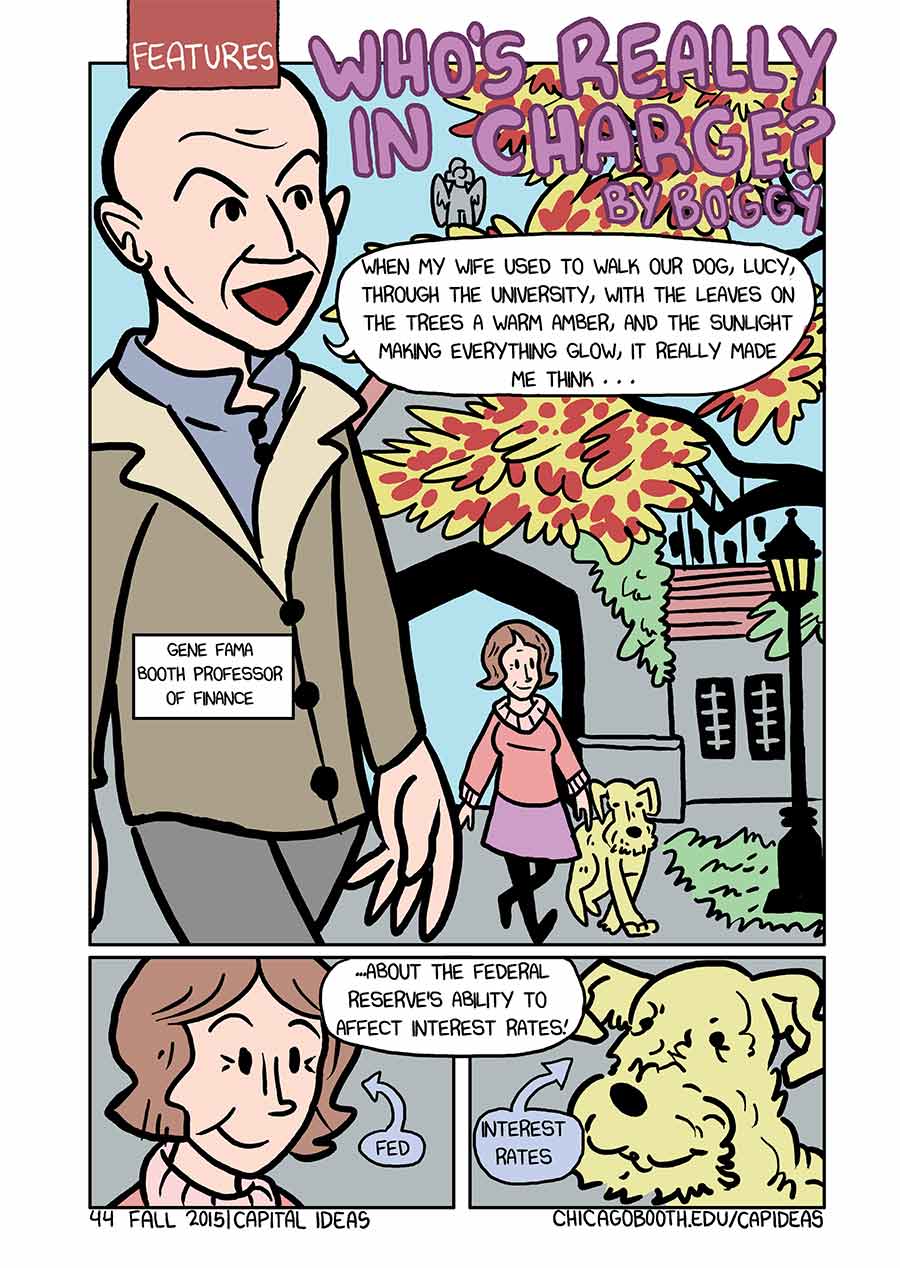
It's a graphic novel treatment of Gene Fama's Does the Fed Control Interest Rates? paper, from the Booth school's Capital Ideas magazine, by Eric Cochrane (yes, we're related). If it appears squished, use a wide browser window. The art is better in the printed form. 

Eric captured cointegration and error correction, and Gene's regressions of short and long-term interest rates, cleverly with the story. Does Sally take Lucy for a walk, or is Lucy really leading Sally around?  Well, when Lucy goes off hunting for a squirrel, who then moves to catch up?  

18 September 2015

5 million thanks


OK, it's not Marginal Revolution. It's not even tops in my own family -- My kids' high-school animation videos do better (8 million here, 5.8 million here). But this blog has worked out far better than I hoped when I started, and I appreciate all of you who read, comment, or otherwise participate.

14 September 2015

Two for growth

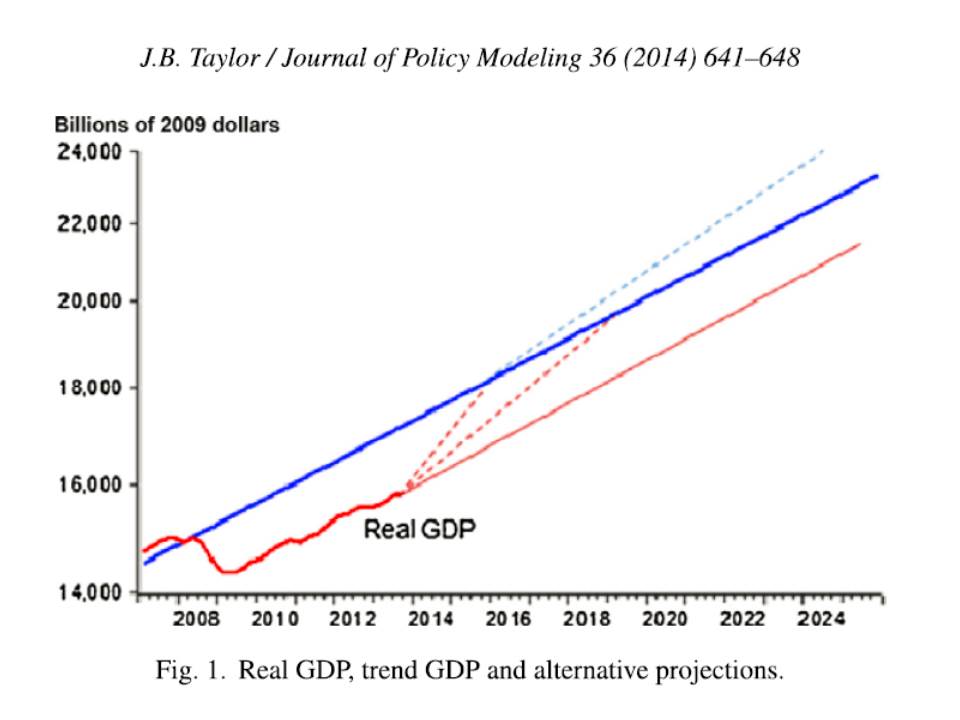
I saw two very nice, short views on growth: John Taylor Can We Restart This Recovery All Over Again? and Andy Atkeson, Lee Ohanian, and William E. Simon, Jr., 4% Economic Growth? Yes, We Can Achieve That.

John gets the art prize


Andy, Lee and William get the boil-it-down-to-basics prose prize
 Safety-net policies should not discourage work through high implicit tax rates resulting from means-tested programs. Regulatory policies should not erect barriers to competition and raise costs. Education policies should expand competition and reward the most successful teachers. Immigration policies should expand the number of skilled workers and immigrant entrepreneurs. And tax policies should simplify the tax code, reduce business and personal marginal income tax rates and broaden the tax base.

11 September 2015

Sargent on Friedman

I ran across a little gem by Tom Sargent, "The Evolution of Monetary Policy Rules." Alas, it's gated in the JEDC so you'll need a university IP address to read it, and I haven't found a free copy. It's a transcript of a talk, so doesn't have Tom's usual prose polish, but insightful nonetheless.

Milton Friedman, like the rest of us, changed his mind over the course of a lifetime.

Coordinating monetary and fiscal policy:
...At different times, Friedman advocated two apparently polar opposite recommendations. In Friedman (1948), he proposed the following rule. He recommended to the fiscal authorities that they run a balanced budget over the business cycle. And he said what the monetary authorities should do, whatever the fiscal authority does, is to monetize 100% of government debt. That monetary rule implies that the entire government deficit is going to be financed with money creation. That is it.

It is interesting to contemplate what Friedman׳s monetary policy rule would imply if the fiscal authority chooses to deviate from Friedman׳s fiscal recommendation by running sustained deficits over the business cycle. Friedman׳s monetary rule then throws responsibility for inflation control immediately at the foot of the fiscal authority. Friedman׳s (1948) monetary rule tells the fiscal authority that if it wants stable money, then it better do the right things. If you want a stable price level, you had better recognize that you need a sound fiscal policy, period.  The division of responsibilities between monetary and fiscal authorities is clearly and unambiguously delineated. It is a completely clean set of rules. And this is what Friedman advocated until 1960.

Friedman (1960) advocated what looks to be exactly an opposite set of rules for coordinating monetary and fiscal policy. Friedman now advocated that the Federal Reserve, come hell or high water – it is not a Taylor Rule (for technical reasons) – should increase high-powered money, or something close to it, at k-percent a year, where k is the growth rate of the economy. The Fed is told to stick to the k-percent rule no matter what, recession or no recession. Under this rule, the arithmetic of the government budget constraint will force the fiscal authority to balance its budget in a present value sense.
What is beautiful about both sets of rules, the 1948 set and the 1960 set, is that they are both very clear descriptions of the lines between monetary and fiscal policy. But the rules ascribe quite different duties to the monetary [and fiscal! - JC] authority.
The line between money and credit
... In his 1960 A Program for Monetary Stability, and also earlier, Friedman embraced the Chicago tradition of 100% reserves for banks, namely, institutions that offer perfect substitutes for government currency. This amounts to setting an iron curtain line between money and credit. Here is the classic Chicago justification: If you want price level stability, you want to prevent shocks that originate in the borrowing and lending markets from impinging on the supply or demand for money. If you want to do that, just do it: 100% reserves basically puts anybody who issues anything that looks like money out of the business of intermediating. But then who intermediates? It would be firms that engage in the business of servicing lenders who are willing to chase higher returns than offered by money by taking term structure and investment risks. That is a socially desirable business, but according to the 100% reserves rule, it is not what banks or the monetary authority should do.

As someone given to qualifying his recommendations, on the very page that he recommends the 100% reserves rule, Friedman cites in a footnote an unpublished paper by Becker (1956) that convinced Friedman that 100% reserves may be exactly the opposite of what you should do. Instead, you should have free banking, but not like Michael Bordo (2014) described in this conference volume. Becker and Friedman really meant free banking. No charters. Free entry. Let anybody issue bank notes if that they want and let the market value them. That is very much like Adam Smith׳s recommendation in the “Wealth of Nations”. In the footnote, Friedman said Becker and Smith might be correct. Then in the text, Friedman proceeded to discuss how you might finance the interest at a market rate that he recommended be paid on those 100% reserves. He said that how you finance those interest payments is an important issue that will affect outcomes.

So even when he recommended one position, Friedman respectfully entertained a diametrically opposed one. Actually, near the end of his professional life, in one of the last papers he wrote with Anna Schwartz, Friedman virtually endorsed free banking, adding some nice words about Hayek (Friedman and Schwartz, 1986).
Is this waffling? No.
Again, the reason I mention Friedman׳s shifting positions is that superficially they seem to be diametrically opposed. They are united at a deeper level by their respect for government inter-temporal budget constraints and their clear division of responsibilities. They are very clear proposals. They’re not ambiguous. They are definite rules. You do not need a dynamic stochastic general equilibrium model to write them down or describe them. But technically, in the instructions to monetary authorities and regulators, they seem to be opposite.

Notice that Friedman does not recommend adopting “something in the middle” – that would confuse issues and only expand a mischievous role for exceptions and “judgment”.

What I take away from all of this is that if Milton Friedman thought that these are tough questions to decide, then they probably are. And they are not going to go away. And if Milton Friedman chose to spend a lot of time thinking about them, then they are probably very important problems to study and resolve.

The rest of the talk is good too, but I've surely exceeded the proper limit for lifting quotes.

18 August 2015

The decline in long-term interest rates

Source: Council of Economic Advisers
Long term interest rates are trending down around the world. And it's not just since the great recession and financial crisis. The same trend has been going on for decades.

The Council of Economic Advisers just issued an excellent report surveying our understanding of this question. A blog post summary by Maury Obstfeld and Linda Tesar.

(Many other interesting CEA reports here. Occupational licensing is next on my in box.)

The report is really well done, for explaining the economic issues in clear simple terms, but without hesitating to use a model and an equation when necessary. If you're wondering how to keep your undergraduate or MBA class (heck, your PhD class) busy this week, this report will do the trick.

There is some grumbling in economics circles about the CEA and what role it should play, between Sunday morning talk show cheerleader for the Administration's policies vs. providing dispassionate  economic analysis to the Administration and country. This kind of report is the kind of CEA I cheer for.

I won't summarize the whole thing. Maury and Linda's blog post blog post does a great job of that, and you should just go read it. A few comments however.


1. Surprise surprise, the trend is a surprise. Hence, beware our current forecasts. This is not a criticism, it's just a fact. The best forecasts have been wrong in the past. They may well be wrong in the future.

2. Said: "The long-term interest rate is a central variable in the macroeconomy. A change in the long-term interest rate affects the value of accumulated savings, the cost of borrowing, the valuation of
investment projects, and the sustainability of fiscal deficits."

Unsaid: The surprise decline in long-term interest rates has been a boon to financing deficits. Current deficit forecasts use the current forecast of a return to higher interest rates. If this forecast is wrong once again, and real interest rates on government debt continue at rock-bottom levels, this will be a boon to "fiscal sustainability." Of course, the opposite is also true: If a trend nobody expected and everyone expects to reverse does reverse, then countries with big debts are in trouble.


3. The long term graph makes nicely a point that's been on the back of my mind lately. People typically assume that long term bonds should pay more then short term bonds, because they are riskier. But that's actually a puzzle: most bond investors hold their money for long periods of time, for which long term real bonds are less risky. It's hard, in fact, to get most term structure models to produce an upward-sloping yield curve.

It was not always so. In the 19th century, short term yields were consistently above long term yields.

The difference, of course, is inflation. In the 19th century we were on the gold standard, as noted in the graph. So long term bonds did not have inflation risk.  So, if inflation continues to die, or if our central banks go on a price level target, we might expect the same pattern to hold again. Which would be great for financial stability too. Short term debt causes runs and crises. If long term debt were cheaper, the inducement to finance short would be less.

4. Uncertainty. A message you read loudly between the lines is, that we have very good theoretical understanding of the various mechanisms that can move the trend in interest rates up or down, we (meaning "economic science") have really very little idea of the quantitative force of various mechanisms. By masterfully explaining each mechanism, and then patiently reviewing the vast literature that comes up with hugely different numbers for each mechanism, the point is made clearly, though between the lines.

They might go further. For example, the section on term premiums (the long rate is the average of expected future short rates plus a term premium) cites the latest studies and plots a line, but no standard error or other uncertainty band around that line. As this is an area I've written papers on, I know where the bodies are buried. Term premium estimates come down to forecasting regressions of future bond returns on current variables. Such regressions have huge bands of uncertainty. All forecasts and decompositions should have error bars. The only problem is artistic, as honest error bars would dwarf the forecasts. Well,  knowing what you don't know is real knowledge.

5. Forecasts. On p. 26, after this implicit devastating critique of the state of knowledge, "To illustrate our analyses, we illustrate different approaches to forecasting the long-term nominal interest rate, as is typically done twice a year in the CEA/OMB/Treasury Budget forecast and midsession review." A process for coming up with a number follows. Clearly, the message of the previous 25 pages is that conditioning decisions on a forecast, cranked out to two decimal places, is a bad idea. Economic policy should embrace uncertainty!

This is really a big deal. Much of the illusion of technocratic competence driving our regulatory state is reflected in absurdly accurate forecasts. The joke goes, we know economists have a sense of humor, because economists use decimal points. I'd love to see a Federal Forecast Accuracy Act: All forecasts made by every administrative agency shall include measures of forecast uncertainty. The CBO will evaluate all forecasts after the fact, and agencies shall be penalized when reality exceeds the stated uncertainty bounds more than half of the time.

6. The CEA ain't buying "secular stagnation," in its perpetual "lack of demand" interpretation.  (As a fact, it's undeniable. The question is the diagnosis and treatment.)  See p. 38.

7. In a report whose summary sections are  Fiscal, Monetary, and Foreign-Exchange Policies, Inflation Risk and the Term Premium, Private-sector Deleveraging, Lower Global Long-run Output and Productivity Growth, Shifting Demographics, The Global “Saving Glut”, Safe Asset Shortage, Secular Stagnation?, and Tail Risks and Fundamental Uncertainty, it is perhaps a bit petulant to complain of left-out factors but I will mention one.

The "supply side" part of the analysis is limited to productivity growth. Higher productivity growth leads to higher real interest rates in equilibrium, and (these days) vice versa. But it takes time and transition dynamics to accumulate capital.

One hypothesis that I learned from Larry Summers is that today's production function needs a lot less physical capital to produce the same productivity. A 1930s steel mill is a lot of accumulated savings. Facebook has nothing but a basketball court sized building full of 20-somethings coding while wearing headphones, and a really cool food court. The company is worth billions but it took comparatively little accumulated savings to start it up. If technology moves so that human, rather than physical capital is the heart of the K in F(K,L), productivity growth may determine interest rates in the long run, but there are lower interest rates on the transition path. Larry:
Ponder that the leading technological companies of this age—I think, for example, of Apple and Google— find themselves swimming in cash and facing the challenge of what to do with a very large cash hoard. Ponder the fact that WhatsApp has a greater market value than Sony, with next to no capital investment required to achieve it. Ponder the fact that it used to require tens of millions of dollars to start a significant new venture, and significant new ventures today are seeded with hundreds of thousands of dollars. All of this means reduced demand for investment, with consequences for equilibrium levels of interest rates.
(This is an update, thanks to email correspondent who found the quote.)

Update: Steve Williamson reminds us all that there is no "the" interest rate, and that the rate of return on capital is both stable and much higher than government bond yields. There is a risk premium, and it's big, and it varies over time. Practically all macro and growth theory forgets this fact. Since I've spent most of my career emphasizing the size and volatility of the risk premium, I should remember this reminder in every blog post. Thanks for pointing it out Steve!

14 August 2015

For better or worse?

Three recent news items and blog posts make a provocative contrast:

Paul Krugman, New York Times,  "The MIT Gang"
It’s actually surprising how little media attention has been given to the dominance of M.I.T.-trained economists in policy positions and policy discourse.... 
James Bartholomew, The Spectator, "British economics graduates have left a trail of misery around the world"
"... the trendy doctrines of our universities have much to answer for" 
(A list that in terms of needless human suffering, is pretty astounding)

Yannis Palaiologos, Politico, Beware of American econ professors!  
World-famous economists — men of Nobel prizes and stellar academic accomplishment — have provided intellectual cover to radicals who appeared at best to be willing to take a stupendously reckless gamble with Greece’s financial, political and geopolitical future, 
To belabor the obvious: Be careful what you wish for.

It is indeed surprising that  little media attention has been given to the dominance of economists trained at MIT in the 1970s in policy positions in US and international organizations.  If a similar dominance from, say, Chicago, or skull and bones, were noticed under a Republican administration and center-right european politics, the media would likely be full of a vast nepotistic right-wing conspiracy.

And given just how much popular opinion thinks of current economic management, it is surprising that Krugman wants more attention to that fact. If the media were to give proper attention, it's not clear they wouldn't write stories like spectator and politico!

Just because politicians find your advice useful, temporarily, doesn't mean you're right. The Spectator article offers chilling counterexamples.


Summers and the nature of policy advice

Larry Summers has a fascinating editorial in the Financial Times titled "Corporate long-termism is no panacea — but it is a start" You really should read the whole thing and come back for commentary.

The three paragraphs in the heart of the editorial are a tour de force:
Businesses will raise wages to a point where the cost is just balanced by the reduced bill for recruiting and motivating workers. At that point, a further increase in wages does not appreciably change their total costs but higher wages certainly makes their workers better off. So there is a strong case for robust minimum wages.
Never mind centuries of supply and demand, centuries of experience with minimum wages and other price controls, or even the current controversies. Never mind that who works for what business and how many do so is a little bit endogenous. Larry has a new and very clever theory about monopsonistic wage setting in the presence of recruitment and motivation costs.  (One that apparently only holds at the lower end of the wage scale where minimum wages bite?)

There is also a strong reason for regulating aspects of pay. Usually competition drives desirable economic arrangements. But not always — especially when there is a risk of a race to the bottom. A company that tries to stand out by offering especially attractive family leave benefits, or job security, or egalitarian wage structures faces the prospect of attracting a disproportionately risk-averse work force. So there is an argument for using mandates to level the playing field.
Once again, bravo. Larry has a new and very clever theory about companies attracting a too-risk-averse pool of workers when they offer benefits instead of pay. (Why are they offering benefits instead of pay? How does this paragraph, in which workers move from job to job, fit with the last one, about bilateral bargaining between fixed workers and firms? ) And an optimal pay mandate can just offset this distortion and give firms the proper pool of risk aversion in its workforce. (Why are excessively risk averse employees a problem? Where do the risk neutral go to work? Why does this not just lead to a different profile of pay vs. benefits to clear the market by risk aversion? )
Profit sharing, too, is an area where there are demonstrable benefits in terms of increased productivity — but an individual company that stands out by offering it may encounter difficulties in recruitment because workers are too risk averse. So there is a strong case for tax incentives to spur profit sharing.
Ditto. "may encounter" is a "strong case" for "tax incentives?"

Ignore my whining, though, and admire the prose. One, two, three, policies enshrined as economic fallacies in Econ 101 classes, are stunningly overturned by clever new theories in three short paragraphs.

My thought: is this really a good way for economists to help to advance public policy?

Larry is the Smartest Guy In The Room.  I mean that, and I mean it as a compliment. I've seen him in action at conferences and other meetings, and his performances are breathtaking. You can see that bravura here. If you have a policy in mind, Larry can come up with three theories to justify it in half an hour, all novel, all clever, all plausible.

But is this at all a service? We all know the elephant (or perhaps I should say donkey) in the room: these are all proposals Mrs. Clinton is making on the campaign trail. For totally different reasons, of course.

Does it really do lots of good to reverse-engineer clever new theories to justify old policies that happen to be politically hot at the moment? And to ignore all the old arguments over those old policies?

Larry's column is great advice for Harvard graduate students. Here are three great thesis topics. Work them out, see if the theory actually holds together (my questions need answering), see if there is a hope of support in the data. You'll have a great thesis.

But is this reverse-engineering great advice for the country?  Shouldn't economics act a little more like science, and keep our clever new ideas as clever new ideas until they have at least some certified theoretical coherence and empirical support?

***

I was also a bit annoyed by the classic missing subject and passive voice that pervades economic policy writing. Just who is going to do all these great things and how?

In this case it's more striking because the prose denies the obvious implicit subject -- the Federal Government. No, it's all going to happen
...not through government actions but through mandates or incentives to change business decision-making." 
And later,
So the idea of achieving reform through altered business behaviour, rather than government programmes, is appealing....
That's important, because of the obvious objection: If these clever new market failures exist, do government bureaucrats have any hope of measuring the distortions well enough to craft a policy? If pay mandates are not about giving one group with political access more pay than others, but to carefully offset an incentive to attract too many high-risk-aversion employees, does the current Department of Labor have a hope of getting it just right?

No, obviously. So it would help a lot if this were not a plea for a hopeless dirigisme. And by using the passive voice with no subject, and explicitly denying this is about government, Larry is trying to overcome that obvious hole in these ideas.

But just who other than the government is going to mandate  mandates, incentivize incentives, alter behaviors, impose "robust minimum wages," enact the "tax incentives to spur profit sharing" do the "regulating aspects of pay" and so on? Is Mrs. Clinton no longer running to be head of a government, but some sort of improve-business do-good website?

The last paragraph attempts an answer
The real need is for a cadre of trusted, tough-minded investors in any given company who can credibly commit to support strong management teams and to provide assurances to a broader investment community so that productive investments are made. Accomplishing that, while maintaining market discipline, is the crucial challenge.
Where is this cadre (!) of investors going to come from? How are they going to take over capital markets? How are these Wise People going to impose the long list of things Larry recommends that only governments can do, including minimum wages, tax incentives, and pay regulation? Just who if not the government is this "crucial challenge" for?

Surely this isn't a pean to the wonders of private equity (Bain capital), who can take companies off the short-termist stock market? Neither Harvard's nor Chicago's endowment managers did a great job of being "long-term" investors, both selling madly in 2008, to say nothing of taking little stance on minimum wages, tax incentives, pay regulation, and so forth. This is not a Summers criticism: university presidents do not direct endowment policy. But if university endowments are not the cadre of wise investors, who are? If (explicitly) not a plea for government intervention, is it a plea for alien invasion or divine intervention?

This part is just inconsistent in a very uncharacteristic way. There is a political discourse that wants to pretend there is a "government lite," that will just nudge us here and there. Unwittingly, perhaps, Larry has set forth quite clearly how empty that promise is.  But why he wants to make this obviously weak argument  I do not understand.

Similarly, the first paragraph is
There are not many wholly new areas to open up in economic policy. But in recent months there has been a wave of innovative proposals directed at improving economic performance in general, and middle-class incomes in particular...
Larry himself provides the counterexample to the idea that corporate short-termism is a "wholly new area"
A generation ago, the Japanese keiretsu system of cross ownership of corporate shares — which insulated corporate managements from share price pressure — was seen as a strength.
What's new, of course, is that the Clinton campaign has taken on these very old ideas.

Why go to such lengths to hide the subject of all these policy entreaties -- very much regulation by the Federal Government -- and pretend the final conclusion is to document a need for a new cadre of investors to parachute in from Mars and take over markets? Why ignore the elephant and donkey in the room when analyzing policy proposals by candidates?

28 July 2015

Mankiw and Conventional Wisdom on Europe

Greg Mankiw wrote a week ago in the Sunday New York Times, ably explaining the  conventional view that the Euro is a bad idea, and that even countries as small as Greece (11 million people) need national currencies. Excerpt:
Monetary union works well in the United States. No economist suggests that New York, New Jersey and Connecticut should each have its own currency, and indeed it would be highly inconvenient if they did. Why can’t Europeans enjoy the conveniences of a common currency?

Two reasons. First, unlike Europe, the United States has a fiscal union in which prosperous regions of the country subsidize less prosperous ones. Second, the United States has fewer barriers to labor mobility than Europe. In the United States, when an economic downturn affects one region, residents can pack up and find jobs elsewhere. In Europe, differences in language and culture make that response less likely.

As a result, Mr. Friedman and Mr. Feldstein contended that the nations of Europe needed a policy tool to deal with national recessions. That tool was a national monetary policy coupled with flexible exchange rates. Rather than heed their counsel, however, Europe adopted a common currency for much of the Continent and threw national monetary policy into the trash bin of history.

Making matters worse, however, was the common currency. In an earlier era, Greece could have devalued the drachma, making its exports more competitive on world markets. Easy monetary policy would have offset some of the pain from tight fiscal policy. Mr. Friedman and Mr. Feldstein were right: The euro has turned into an economic liability that has exacerbated political tensions. For this, the European elites who pushed for the currency union bear some responsibility.
I am a big euro fan. This seems a good moment to explain why I don't accept this conventional view, despite its authority from Milton Friedman to Marty Feldstein and Greg Mankiw and even to Paul Krugman.

Short: I am also a big meter fan. I don't think each country needs its own measure of length, or to shorten it when local clothiers are having trouble and would like to raise cloth prices.

Longer: This conventional view is deeply old-Keynesian. In this view, each region, including ones as small as Greece (11 million) or Ireland (4.6 million), less than the Los Angeles metro area (13 million), suffers "demand" shocks, which governments must actively offset with fiscal stimulus or monetary policy.

This strikes me as one of those many stories that people repeat all the time until they believe it, but whose foundations are seldom examined.  (There is a "thesis topic" label here for such examination. Comparisons of US states to European countries on these dimensions seems fruitful.)

What are these local demand shocks for small open economies in the eurozone? "Aggregate demand" is, well, aggregate, not regional.  Changing fortunes of local industries is more what we call "supply," not "demand." For small open economies (LA) much "demand" comes from other cities and states, not local.

What is this "fiscal union," apparently providing countercyclical Keynesian stimulus at the right moment?  In the US, we have Federal contributions to social programs such as unemployment insurance. Europe has the common agricultural policy and many other subsidies. We do not have systematic, reliably countercyclical, timely, targeted, and temporary local fiscal stimulus programs. Just how big is the local cyclical variation in state or local level government spending or transfers? (And why does fiscal union matter so much anyway? If you're a Keynesian, then local borrow and spend fiscal stimulus should be plenty. The union matters only when countries near sovereign default and can't borrow.)

The local and cyclical qualifiers matter. Yes, both US and Europe have some pretty large cross-subsidies. But most of these are permanent. The rest of the nation subsidizes corn ethanol to Iowa year in and year out. Social security payments come year in and year out, and transfer money from states with workers to those with retirees. Monetary policy has at best short-run effects, so the argument for currency union has to be about local cyclical, recession-related variation in economic fortunes, not permanent transfers.

And Federal fiscal transfers only started in the 1930s. We had a currency union in 1790, and no substantial Federal fiscal transfers at all until the 1930s. How did we get along all this time?

A sense in which this is a centrally old-Keynesian argument is that Greg is not making a second, common, and also wrong (in my view) case for national currencies: the view that currency union demands central bailouts of sovereign debt.  No, Greg (and the conventional wisdom he echoes) has in mind only the necessity of Keynesian countercyclical policy. Aphorisms such as "currency union demands fiscal union" are dangerous, as they have many meanings.

So, this conventional view presumes that there really are big regional "demand" shocks; that there is a big, important Keynesian fiscal multiplier, even away from the zero bound, and that our government really does a lot of recession-related fiscal transfers, larger than Europe's (agricultural subsidies, etc.) and that the US pre WWII was a disastrous too-large currency area. I'm not convinced on any of these points.

(To be sure, I will admit a multiplier of about one for state to state transfers. If the federal government takes money from the citizens of New York, and sends the money to people in Florida,  businesses will move from New York to Florida to follow the money and GDP will rise in Florida. And decline in New York.)

Consider Greece, "In an earlier era, Greece could have devalued the drachma, making its exports more competitive on world markets. Easy monetary policy would have offset some of the pain from tight fiscal policy." So, Greece's GDP is falling because of "tight fiscal policy?" Calamitous regulation, corruption, closed markets, and now closed banks, frozen payments are not relevant? Tight fiscal policy? Greece is still running primary deficits. After blowing through one and a half GDP's worth of what are now transfers from the rest of the EU, they've run through another half a GDPs' worth, and GDP collapses more. Really, Greece's economic problems are.... a lack of adequate borrowing and spending? And all Greece needs is one more devaluation, and suddenly will be shipping Porsches to Stuttgart in return for worthless pieces of paper rather than the other way around?

Greg passes on the labor mobility story. Here too I'm dubious and curious to see numbers. The story is also told that there is less and less labor mobility in the US, especially of people leaving dying regions. And there are lots of Polish-plumber stories from Europe, that open borders leads to lots of migration.  Here again, cyclical migration, on the scale for which  monetary policy can substitute, seems unlikely. How big are business-cycle frequency migration flows across states in the US vs. Europe?

Again, the US  until 1933 poses an interesting challenge. Your school stories of westward migration were not a business cycle frequency response to demand shocks. And when people traveled by horse or foot, the vast majority of Americans never moved more than 20 miles from where they were born. The costs of labor mobility in Europe today are vastly smaller than the costs of labor mobility in the US 19th century.

Conversely, and perhaps more centrally, I  less trusting of the stabilizing influence of central banks. Dispassionate omniscient central banks can, in theory, wisely spot demand shocks and cleverly devalue currencies to offset them, while not responding to supply shocks, political demands, and so forth. The same technocrats could quietly redefine the meter as needed to let tailors respond to shocks without changing prices.

But the history of small-country central banks is not so reassuring. Grece and Italy's repeated devaluations and inflations did not bring great prosperity.

Joining a common currency is a pre-commitment against bad monetary policy as well as foreswearing of hypothetical good monetary policy. Political forces seldom think there's enough stimulus.  When Greece and Italy they joined the euro, they basically said, defaulting and inflating now will be extremely costly. They were rewarded for the precommitment with very low interest rates. They blew the money, and are now facing the high costs they signed up for. But that just shows how real the precommitment was.

Micro, macro and politics interconnect. The case for separate currencies is to protect the economy from sticky wages, sticky prices, and sticky people. But none of these stickinesses are written in stone. A plausible answer to my question about pre-new deal US is that prices and wages were not sticky (whatever that means) before the era of regulation. Well, that is a loss, and only very imperfectly addressed by artful devaluation of the currency.  Not every block can have its own currency, so local and industry variation within a country remains hobbled by sticky prices, wages, and people. If sticky wages,  prices and people are the central economic problem, we ought to have a lot of policies to unstick them. We do the opposite, and Europe even more so. The very social programs that Greg implicitly praises for fiscal stimulus tie people to location and undermine labor market flexibility.

The strongest case for a separate currency might come from a small economy like Chile, which sells one product (copper), subject to big price fluctuations, and otherwise is pretty closed, and has institutions with sticky nominal wages that it doesn't want to fix. When the price of copper declines, price times marginal product of labor declines, so real wages should decline, and the value of haircuts provided to copper miners should decline as well. Chile may prefer to keep nominal wages steady and let the exchange rate rather than wage rate discourage imports.

But even Chile exports a lot more than copper these days. Texas is still booming despite a large decline in oil prices. The same argument does not hold for company towns within the US, which do not use their own currency. Stanford  has extremely sticky wages (tenure), and suffers "demand" shocks, (positive lately), without offsetting fiscal stimulus and tremendous labor immobility. It takes a year to hire faculty. But nobody thinks Stanford should have its own currency, and periodically devalue that currency. Why not? Because we are open.

So I think a lot of the conventional view seems to think implicitly of fairly closed economies, operating in parallel. But Europe's economies are open. Moreover, the whole point of the eurozone is to open them further. Small open economies are much worse candidates for their own currency.

Surely each block should not have its own currency, nor each city. We'd probably all agree that very small countries should not -- Luxemburg, say. So the question is really whether the Greece that Greece wants to be -- more open than today -- is effectively of the same size.

So, to sum up, Greg's article very nicely summarizes the conventional view. Recognize that this conventional view is deeply old-school Keynesian, both in its view of fluctuations, the need for constant "demand" management, and the success of "demand" managers to do their job. There is room for disagreement on that theory, and more productively on the underlying facts Greg passes on.


27 July 2015

Ben-Gad and the Minotaur

Michael Ben-Gad has a smashing review, "Into the Labyrinth", of Yanis Varoufakis' The Global Minotaur (Disclaimer: I have not read it and don't intend to.) It's a great piece of writing as well as a cogent analysis. Some excerpts:
"The idée fixe that dominates The Global Minotaur, and apparently dominated Mr Varoufakis’s squabbles with the other Eurogroup ministers of finance, is that some countries are inherently more productive than others and therefore always generate current account surpluses, while others always generate deficits, and fixed exchange rates or monetary unions only exacerbate this imbalance. Hence, for the world economy to function, the surpluses need to be recycled though a system of regular transfer payments from the core to the periphery.
Why do these imbalances emerge? According to the theory of comparative advantage as formulated by David Ricardo in the early 19th century, different countries specialise in the production of particular goods and then exchange them for others, and trade is mutually beneficial even if some countries are more efficient at producing all goods. Mr Varoufakis’s theory rejects all this. Instead, he argues, some countries are destined to specialise in the production of goods and services, while others on the periphery will forever specialise in consuming them. Put into layman’s terms, what this means is that the people of Germany, the Netherlands, and Finland produce cars, wooden clogs, or mobile phones and sell them to the people of Greece, who pay for it all with money – and to make this trade sustainable the cash needs to be regularly replenished in an endless loop by the people of Germany, the Netherlands, and Finland.
This is a story we hear quite often beyond Mr. Varoufakis -- that a currency union requires countries to be similar, with similar productivity. I'm glad to see it so effectively skewered. In Ricardo's famous example, Portugal sells wine to Britain, which sells wool to Portugal, even if one is better at both than the other. They were on a common currency, gold.

On predictable US-bashing:
In Mr Varoufakis’s world the biggest villains are companies such as Walmart that exploit their efficiency to immiserate communities by making them pay less And of course the worst thing about Walmart is that it is American.
....Apparently, between the end of the war and the collapse of the Bretton Woods agreement in 1973, the Americans had a global plan, helpfully labelled ‘the global plan’, to dominate the world by permanently running current account surpluses and paying down its debt. Then this ended and was replaced by a new global plan to dominate the world by running permanent current account deficits and letting its debt soar. Devious Yanks. 
This last paragraph gets the golden skewer award for prose.
First,  he would have all remaining government debts still owed to banks written off. Why? Well, everyone hates banks, and it is apparently a neoliberal myth that their shares are owned by pension funds, university endowments or just ordinary people saving for retirement. Banks are really owned by Bond villains who live underneath hollowed-out volcanos.
Second, a substantial part of the remaining debt – about 60 per cent of GDP – would be mutualised across the eurozone so that, whenever the spirit moved them, governments could costlessly default on their bond payments, each one safe in the knowledge that any repudiated debt would immediately become an obligation for the taxpayers in the 18 remaining countries – unless, of course, they defaulted first. This is a variation on the prisoner’s dilemma game, but on steroids. 
Oh, I give up, just go read the whole thing.

Then read his equally good review of Thomas Pikettty, from a year ago, which starts
Reading Thomas Piketty’s Capital in the Twenty-First Century from front to back was a mistake.
Better to read the last hundred pages first, with their recommendations for the confiscation of wealth and marginal income tax rates nearing 100 per cent, and then read the preceding 470 pages to decide whether the flimsy evidence, conjecture and questionable theories the author offers justify such draconian measures....

18 July 2015

The other Smith on Growth

In a recent Bloomberg piece, "Growth Fantasy of Tax Cuts and Small Government" Noah Smith took on my recent blog posts on 4% growth. In the first, I outlined the historical evidence that yes, the US has grown at 4% quite often. In the second, I outlined the standard smorgasbord of free-market policies which I suggested would increase our growth, at lest by inducing a substantial level shift.

Noah's main point is that in my blog posts I did not make any substantive quantitative claims that moving our country from the Republic of Paperwork to Adamsmithia would return the US to the kind of growth we saw in the 60s, late 80s and 90s. True enough.

My surprise in reading Noah is that he provided no alternative numbers and no alternative policies.  Well, if you don't think Free Market Nirvana will have 4% growth, at least for a decade as we remove all the level inefficiencies, how much do you think it will produce, and how solid is that evidence? He rambled a bit about the predictive value of some state scoring efforts, but that's all quite beside the central point -- how much growth could the best imaginable economic policy, at a national level, produce?

More deeply, Noah suggests no alternative policies. He does not claim that more government wage controls,  unions, stricter labor laws (Uber drivers must be employees) heavier and more politicized regulation, cartelizing more industries beyond health and finance, raising taxes to confiscatory levels, larger welfare state, boondoggle public works and so on -- the alternative path in the current policy debate -- will get us back to 4% growth.

So, one must only conclude that Noah -- and others voicing the same it's-not-possible complaint -- believes 4% growth is not possible. 2% or less is the new normal. Sustained growth, of the sort that made us all healthier and wealthier, if not wiser, than our grandparents, is a thing of the past. So all we can do now is fight to carve up a shrinking pie, retreat from an increasingly chaotic world, and pretend that carving up the pie will not shrink it further.

I am surprised at this pessimism, both economic and political. If the absolute best economic policies anyone can imagine -- and, again, Noah offered no alternatives -- cannot return us to 4% growth and sustain that growth, why bother being economists? They do not call us the "dismal science" because we think the current world is close to the best of all possible ones, and all there is to do is haggle over technical amendments to rule 134.532 subparagraph a and hope to squeeze out 0.001% more growth. Usually, the role of economists is to see the great possibilities that every day experience does not reveal. ("Dismal" only refers to the fact that good economics respects budget constraints.)

Similarly, the next US presidential election looks to be an argument over growth vs. redistribution. I doubt that many Americans are so willing to abandon hope so soon.  Even Hilary Clinton's latest speech took the view that reducing inequality would raise growth -- a novel argument (relative to 250 years since Adam Smith) that invites similar theoretical and quantitative evaluation, but at least one that does not give up on growth.

Noah's tired pot-shot has been going on a long time. In 1980 Ronald Reagan announced some pretty radical growth-oriented policies, at least by the standards of the time. (Not much new since Adam Smith, of course.) The standard liberal commentators made the standard objections: voodoo economics, numbers don't add up, it will take generations of unemployment to lower inflation, the debt will explode, and so forth. (Plus, the Soviet Union will be there forever, we might as well get along.)  Reagan offered optimism; won, malaise ended, we won the cold war, and there was an economic boom. One would think the tired argument would have less force by now, or that the pessimists would have found a better one.

17 July 2015

Learning and New Keynesian Models.

John Barrdear at the Bank of England just posted an interesting paper, Towards a New Keynesian theory of the price level. Like Garcia Schmidt and Woodford, it changes the information structure of the standard model to avoid the standard model's problems.
Modifying the standard New-Keynesian model to replace firms' full information and sticky prices with flexible prices and dispersed information, and imposing mild and plausible restrictions on the monetary authority's decision rule, produces the striking results that (i) there exists a unique and globally stable steady-state rate of inflation, despite the possibility of a lower bound on nominal interest rates; and (ii) in the vicinity of steady-state, the price level is determinate (and not just the rate of inflation), despite the central bank targeting inflation. ... The model admits a determinate, stable solution with no role for sunspot shocks when the monetary authority responds by less than one-for-one to changes in expected inflation, including under an interest rate peg....
I haven't read this one yet either. I'm posting for anyone following these issues. Like Garcia Schmidt and Woodford, I also hope that others will read the papers and help to figure out if they really work as advertised.

16 July 2015

Miles Looks Back

David Miles, retiring from the Monetary Policy Committee of the Bank of England, gave a fascinating speech on the occasion.  (Pdf with graphs here.) David's voice is particularly interesting since he's a real-world central banker, not an ivory-tower academic who can afford to have radical views. Many central bankers seem to evolve to the view that yes, they can push all the levers and run things just right. Not David.

Looking back: lessons from the global financial crisis
..the simplest, and arguably most effective, policy [to avoid financial crises] may well have low long run costs. That policy is to gradually change the funding structure of banks so that they are much better able to deal with shocks by relying less on debt and more on equity...

There are two fundamental reasons why having financial intermediaries fund their acquisition of assets with significant amounts of equity makes sense. First, it directly addresses the problems of improving incentives and preventing even limited falls in expected asset values triggering big rises in perceived risks of insolvency. Consider why the very large fall in asset values after the dot.com bubble burst did not have such devastating effects on the US economy. It was because all that frenzied activity was largely financed by equity and not debt. People who had funded much of the dot.com bubble lost money, but this did not trigger a whole series of insolvencies in the financial sector and disrupt the flow of credit to the wider economy.

Second, the long run cost of even rather big increases in the amount of equity funding of financial intermediaries is plausibly quite small. Substantial changes in the use of equity funding have already taken place since the crisis – and on some metrics required capital is as much as ten-times greater than pre 20087. And yet there is little evidence that the overall cost of bank funding has increased substantially. The paths of bank lending rates, both in absolute terms and relative to Bank of England Rates, have tended to fall (charts 2 and 3). And direct measures of the cost of bank funding have been on a steady declining path as capital ratios have risen (chart 4).
But won't the cost of capital rise and thus the cost of loans rise?
Simple finance theory suggests why, starting from very low levels of equity (high debt leverage), the impact of large proportionate changes in the use of equity on the overall cost of funds is likely to be small.

Consider the impact of doubling capital – or halving leverage – using the simplest possible back of the envelope calculation of a bank’s weighted average cost of funds. Suppose we start with leverage of 40 and cut it to 20 (that is with equity initially of 2.5% of total assets rising to 5%). Let’s imagine that the cost of debt financing is 5% and the required return on equity (its cost) at the original level of capital is 15%. First, if we assume that these costs will not change (a pretty big and unrealistic ‘if’ for a dramatic change in leverage), this will lead to total cost of financing increasing from 5.25% (0.975*5%+0.025*15%) to 5.5% (0.95*5%+0.05*15%), a rise of only 0.25pp. 25 basis points is what people used to think of as one typical MPC rate change at its monthly meetings.

And this is an extreme case in which the costs of equity and debt do not change. Theory suggests they should change so as to reflect the shift in riskiness as equity rises – debt becomes safer and equity returns less variable. At the extreme (and if the conditions for the famous Modigliani-Miller (MM) theory hold) there would be no change in the weighted cost of funds.
I hadn't thought of this. Even if MM is completely false for banks, the actual rise in costs of capital is small.
A combination of the limited liability of shareholders and deposit insurance almost certainly makes MM not hold for banks. But many of these factors may mean that while MM does not hold, the private cost of banks using more equity is not a true social cost.
In simpler terms, equity financed banks may face a higher cost of funds, because our governments subsidize debt. That fact does not mean that society as a whole as a higher cost of borrowing through equity-financed banks.

David goes on to an interesting question: Let us compare equity financed banking to the current rage, using monetary policy to identify and prick asset price "bubbles."
Might it then be that a better way to control risk taking and financial fragility is to use ...changes in the general level of interest rates ...

My own view is that skewing monetary policy towards trying to stop financial instability problems is, in general, unlikely to be the right answer. Yet many seem to think that the crash showed that having narrower aims of monetary policy – centred around an inflation target – was somehow proved wrong. I think that view fails to look at the deep reasons for the crash, which to my mind were the existence of excess leverage (too little equity funding) in banks. Excess leverage is not something effectively countered by a general rise in the level of interest rates. Higher interest rates will tend to increase required returns on both debt and equity and so it is not at all clear they encourage the use of relatively more equity. Capital requirements – a macro prudential tool – get to the heart of the problem.
I'm less in love with the "macro prudential" agenda, but in this case I cheer.

David makes another interesting point:
..bankers are right to say: For them raising equity is costly; and imposing a higher capital requirement will reduce aggregate lending.

Both statements are correct. But both miss the point. There may be too much lending in the unregulated state. Equity may look costly to banks but it has an overall beneficial side effect in better aligning the interests of shareholders with those of other claimants on the bank. To put the point another way: there is an inherent tendency in banking markets for there to be excessive risk taking. 
This is a nice point, which had not occurred to me. If the cost of debt financing rises, borrowers may choose equity financing instead. It's not obvious that the total amount of investment declines, or that it declines in a socially inefficient way. There is such a thing as too much debt!

Lessons about Monetary Policy: QE, ZLB and deflation
The global recession led many central banks to lower their policy rates to near zero. With the exception of in Japan, this was pretty much unchartered territory for monetary policymakers...

...the predictions from mainstream theoretical macroeconomic models for what would come next were not comforting... [For example] Eggertsson and Woodford (2003, EW) had analysed what happens at such low levels of policy rates and the likely effectiveness of asset purchases. They suggested that on hitting the lower bound an economy could suffer a deep deflation and recession and that asset purchases were not likely to help much. Their analysis suggested that the effective way to avoid deflation in such circumstances would be to commit to future inflation overshooting the target.

I found these predictions somewhat unrealistic, ...

I also doubt that there is a deflation cliff at the ELB. The evidence for thinking that deflation risks become great at the ELB is actually quite weak. There were no dramatic deflations among OECD economies (except for Ireland, which saw an exceptionally sharp fall in economic activity), and there was no clear difference in the change in inflation rates between countries that were constrained by the ELB and those that were not. Inflation fell in most OECD countries in 2009, but only a few experienced outright deflation.

... Neither actual nor expected inflation displayed the deflation cliff at the effective lower bound.
He's not quite "neo-Fisherian." But clearly the prediction of a deflation "spiral" or "vortex" at the zero bound troubled him at the start -- as it should have -- and no longer sits well.

I disagree mildly on the effectiveness of quantitative easing. David seems to think it worked. And his story for the absence of deflation seems to be in part that QE stopped it. But, he acknowledges Ben Bernanke's famous quote, "the problem with QE is that it works in practice, but it doesn’t work in theory." I'm reluctant to really believe anything works until we have at least a vaguely plausible understanding of how it works. Doctors believed in bleeding for a long time. One can see though how practical experience and academic reserve might differ here.

15 July 2015

Behavioral Public Choice

In a number of blog posts, (here ) I've complained about the lack of behavioral public choice theory, and highlighted some efforts in that direction.

Much behavioral economics documents that people do stupid things, and then jumps to the conclusion that parternalistic government can do things for us better. But wait, those government functionaries are also human, also behavioral, and placed in group and social settings that psychology as well as economics warns us are particularly prone to bad outcomes.

Marginal revolution highlights an interesting new paper that breaks in to this field, Behavioral public choice: The behavioral paradox of government policy by Ted Gayer and W. Kip Viscusi. A quote:
In this article we examine a wide range of behavioral failures, such as those linked to misperception of risks, unwarranted aversion to risk ambiguity, inordinate aversion to losses, and inconsistencies in the tradeoffs reflected in individual decisions. Although such shortcomings have been documented in the behavioral literature, they are also reflected in government policies, both because policymakers are also human and because public pressures incorporate these biases. The result is that government policies often institutionalize rather than overcome behavioral anomalies.
I haven't read it, but it seems interesting, and the field seems wide open. The defense of freedom never was that freedom is perfect, merely that government control is worse.

I am interested that behavioral economics seems so focused on mistakes of individual decision making, as nicely summarized in the quote. In fact the most obvious thing about humans is that we are social animals, not that we are poor individual decision-makers. I would think that behavioralists would be bringing social psychology more than individual decision making to economics. But maybe this just reveals how little I know about either.

14 July 2015

Garcia Schmidt and Woodford on neo-Fisherian economcs

Mariana Garcia Schmidt and Mike Woodford are lighting up the internet with a presentation on neo-Fisherian economics -- the proposition that, when we are satiated in money as at the zero bound or with interest on reserves, raising interest rates raises inflation. Noah Smith, Marginal Revolution, Brad DeLong, and indirectly at Mark Thoma's econbrowser.

This is a particularly important voice, as it seemed to me that standard New-Keynesian models produce the new-Fisherian result. i = r + Epi is a steady state in all models. In old-Keynesian models, it was an unstable steady state, so an interest rate peg leads to explosive inflation or deflation. But in new-Keynesian models, an interest rate peg is the stable/indeterminate case. There are too many equilibria, but if you raise interest rates, inflation always ends up rising to meet the higher interest rate.

What I can glean from the slides is that Garcia Schmidt and Woodford agree: Yes, this is what happens in rational expectations or perfect foresight versions of the new-Keynesian model. But if you add learning mechanisms, it goes away.

My first reaction is relief -- if Woodford says it is a prediction of the standard perfect foresight / rational expectations version, that means I didn't screw up somewhere. And if one has to resort to learning and non-rational expectations to get rid of a result, the battle is half won.

But that's only preliminary relief. Schmidt and Woodford promise a paper soon, which will undoubtedly be well crafted and challenging.

For more on the issue, here is a a previous blog post. Section 3.1 ff of "Monetary policy with interest on reserves" has a full new Keynesian model with the Fisherian result. And a wry prediction: the Fed will raise rates to head off inflation, that will cause the inflation, then the Fed will congratulate itself on having headed off the inflation.  I also suspect that models with restricted liquidity (no interest on reserves) do give a temporary decline in inflation, but without that liquidity we now will get full Fisherian results. But that's just a conjecture so far.  My last foray into learning in new-Keynesian models, which didn't end well.

Why post now? Garcia Schmidt and Woodford clearly will have a thoughtful and sophisticated paper, on what I think is a deep and important point. I hope to encourage others to read and help to digest the paper.


06 July 2015

China crash?

Meanwhile, on the other side of the world, China is doing everything in the textbook to ignite a "bubble."

I dislike that usually undefined term, which carries a lot of normative baggage. But there are a set of steps that governments often take unwittingly and are later criticized for. China's doing them on purpose. And these steps quite often precede large market declines.

Short sales ban: Financial Times: "opened a probe into market manipulation"  ... "The investigation is likely to focus on short selling."  The usual witch hunt, with Chinese characteristics. Owen Lamont has a splendid paper on what often follows short-sales bans. The weekend before TARP and Lehman, the US instituted a short-sales ban on bank stocks, just in case there was someone out there who did not know banks were in trouble and they should sell now. Europe instituted a CDS selling ban in the first PIGS crisis...

Lending to encourage highly leveraged speculation: Wall Street Journal: "Under the planned move, China’s central bank will indirectly help investors borrow to buy shares in a market that had already seen a rapid buildup in debt from so-called margin financing." Procyclical credit supply is named by just about every account of a "bubble" followed by a crash.

Prices depend on supply and demand. As well as increasing demand, limit supply: "A halt to new stock listings."

And more. Quartz offers "A complete list of the Chinese government’s stock-market stimulus (that we know about)" including  "People’s Bank of China will “provide liquidity assistance” to China Securities Finance Corp., a company owned by the stock regulator. The company will use the money to lend to brokerages, which could then make loans to investors to buy stocks."

This scenario often ends badly.

The only thing I can think of that can actually stop a crash is for the central bank to directly print money to buy stocks. And not just a little bit. A pre-announced and limited quantity won't work. The US QE took billions to alter bond prices a few basis points at most. One has to commit to a price floor and a "do what it takes" amount of money, no matter how large or inflationary. I don't know of it ever being tried. It will be interesting to see if China goes that far. They could hide the fact with extensive bailouts of people "borrowing" to buy stocks, or otherwise cover losses or promise to cover losses.

Of course, the right strategy is to leave it alone. The whole point of stocks is that they go down on occasion, without runs, without defaults, and without financial distress. Unless the people and institutions holding them are highly leveraged. Didn't we just learn this lesson?


30 June 2015

Kashyap on Greece

Anil Kashyap has an excellent summary of the Greek debt crisis.

He sees government printed IOUs as a much better solution to the banking and payments crisis than for Greece to exit the euro and try to reestablish the Drachma. I agree entirely.

His summary goes back to the beginning, and reminds us that Greece did not get bailed out; Greece's creditors (mainly european banks) got bailed out.


29 June 2015

Wages and inflation

Marty Feldstein has a very interesting opinion piece on Project Syndicate. His main point is that micro distortions from social programs (and taxes, labor laws, regulations etc.) are leading many people not to work, and is well stated.

An introductory paragraph poses a puzzle to me, however,
Consider this: Average hourly earnings in May were 2.3% higher than in May 2014; but, since the beginning of this year, hourly earnings are up 3.3%, and in May alone rose at a 3.8% rate – a clear sign of full employment. The acceleration began in 2013 as labor markets started to tighten. Average compensation per hour rose just 1.1% from 2012 to 2013, but then increased at a 2.6% rate from 2013 to 2014, and at 3.3% in the first quarter of 2015.
These wage increases will soon show up in higher price inflation. 
This is a common story I hear. However I hear another story too -- the puzzle that the share of capital seems to have increased, and that real wages have not kept up with productivity.

So, maybe we should cheer -- rising real wages means wages finally catch up with productivity, and do not signal inflation. The long-delayed "middle class" (real) wage rise is here.

I'd be curious to hear opinions, better informed than mine, about how to tell the two stories apart.  

20 June 2015

Econ 1


John Taylor is offering his Economics 1, the introductory economics course for Stanford undergraduates, as a free online class. Class starts Monday, June 22.

John's blog post here, and registration page here.

Yes, Martha, apparently there is a free lunch.

27 May 2015

Tucker and Bagehot at Hoover

I had the pleasure last week of attending the conference on Central Bank Governance And Oversight Reform at Hoover, organized by John Taylor.

Avoiding the usual academic question of what should the Fed do, and the endless media question will-she-or-won't she raise rates, this conference focused on how central banks should make decisions. Particularly in the context of legislation to constrain the Fed coming from Congress, with financial dirigisme and "macro-prudential" policy an increasing temptation, I found these moments of reflection quite useful.

Some of the issues: Should the Fed follow an "instrument rule," like the Taylor rule? Should it have "goal," like an inflation target, but then wide latitude to do what it takes to attain that goal? What structures should implement such a rule? Implicit in a rule that the Fed should do things, like target inflation and employment, is an implicit rule that it should ignore others, like asset prices, exchange rates and so on. (I think this is much too often overlooked. As financial reform should start by delineating what is not systemic, and hence exempt from regulation, monetary policy rules should start by saying what the Fed should ignore.) Should that limitation be more explicit? What's the right governance structure? Should we keep the regional Feds? How should Fed meetings be conducted? Is "transparency" the enemy of productive debate? How much discretion can an agency have while remaining independent?  And so on.

I was going to post thoughts on he whole conference, but John Taylor just posted an excellent summary, so I'll just point you there.

My job was to discuss Paul Tucker's (ex Deputy Governor of the Bank of England) thoughtful paper, "How Can Central Banks Deliver Credible Commitment and be “Emergency Institutions" Paul's paper starts to think deeply about independent regulatory agencies in general, and monetary and fiscal policy together. My discussion is narrower. I'll pass on the discussion (pdf here) as today's blog post, as it might be interesting to blog readers.

Comments on “How Can Central Banks Deliver Credible Commitment and be “Emergency Institutions” By Paul Tucker
May 21 2015

Let me start by summarizing, and cheering, Paul’s important points.

The standard view says that perhaps monetary policy should follow a rule, but financial-crisis firefighting needs discretion; a big mop to clean up big messes; flexibility to “do what it takes”; “emergency” powers to fight emergencies.

I think Paul is telling us, politely, that this is rubbish. Crisis-response and lender-of-last-resort actions need rules, or “regimes,” even more than monetary policy actions need rules. At a basic level any decision is a mapping from states of the world to actions. “Discretion” just means not talking about it.

More deeply, you need rules to constrain this mapping, to pre-commit yourself ex-ante against actions that you will choose ex-post, and regret. Monetary policy rules guard against “just this once” inflations. Lender of last resort rules guard against “just this once” bailouts and loans.

But you need rules even more, when the system responds to its expectations of your actions. And preventing crises is all about controlling this moral hazard.

To stop runs, our governments guarantee deposits and other loans; they bail out institutions and their creditors; they buy up assets to raise prices, and they lend like crazy. But knowing this, financial institutions take more risk than they would otherwise take, and investors lend without monitoring, making crises worse. Institutions that can borrow at last resort don’t set up backup lines of credit, don’t watch the quality of their collateral, and don’t buy expensive put options and other insurance, making crises worse. Investors who know that the Fed will stop “fire sales,” don’t keep some cash around for “buying opportunities,” making fire sales worse. “Big banks are too complex to go through bankruptcy,” the mantra repeats. But why do people lend to them, without the protections of bankruptcy? Because they know creditors, if not management and equity, will be protected.

“The world is ending. A crisis is no time to worry about moral hazard,” bankers and government officials told us last time, and will tell us again. But the world does not end, and actions taken in this crisis are exactly the cause of moral hazard for the next one.

This isn’t theory. When the Fed and Treasury bailed out Bear Stearns, and especially its creditors, markets learned “Oh, Fed and Treasury won’t let an investment bank broker-dealer go under.” Lehman turned down capital offers, and Reserve Fund losses on Lehman paper were enough to cause it to fail in a run. (This is an update: see below.)

The severe crisis and recession coincident with Lehman’s failure, together with the massive and improvised response — many flavors of Tarp, auto company bailouts, and so on — have arguably created the “rule” in participants’ minds about what will happen next time.

Plans, self-imposed rules, promises, guidance, and tradition are not enough. Given the power, every one of us will bail out. We won’t risk being the captain of the Titanic, and we’ll let the next guy or gal deal with moral hazard. A central banker facing a crisis is like a father holding an ice cream cone, facing a hungry three-year old. Sure, Mom’s rule says dinner always before dessert. We know what’s happening to that ice cream cone.

The central bank and Treasury must not be able to bail out what they should not bail out, to lend where they should not lend, to protect creditors who should lose money. That’s the only way to stop it. More importantly, it’s the only way to persuade the moral hazarders that all the fine words in the boom will not melt quickly in the emergency.

Two central quotes summarize the Tucker view, and I entirely agree.
Prerequisites for any such regime are that its terms should mitigate the inherent problems of adverse selection and moral hazard; be time-consistent; and provide clarity about the amount and nature of ‘fiscal risk’ that the central bank is permitted to take on the state’s behalf.
At a schematic level, a money-credit constitution for today might have five components: inflation targeting plus a reserves requirement that increased with a bank’s leverage plus a liquidity-reinsurance regime plus a resolution regime for bankrupt banks plus constraints on how the central bank is free to pursue its mandate.
***

Now, let me offer a gentle critique.

How are we doing towards the Tucker regime? Not well.

The Dodd-Frank and Basel “regime” has no serious limits at all. Ask yourself, what institutions are not “systemic” and cannot become so designated? What institutions or creditors won’t be bailed out; can’t be bailed out? What are the securities the Fed or Treasury won’t and can’t  buy or lend against? What are the asset prices prices that they won’t and can’t prop up?

Paul points out the difficulties. Yes, “constraints” are good. But just what constraints? We can channel Bagehot, “against good collateral,” to “illiquid but not insolvent” institutions. Except, as Paul reminds us, what’s good collateral, when noone will take anything but Treasuries? How do you tell illiquid from insolvent when prices have tanked and markets are frozen? It’s not so easy.

More deeply, the Bagehot rules are flawed. If it were clear who is illiquid and who is insolvent, there wouldn’t be a crisis. Private lenders would happily support the clearly solvent. And runs happen at institutions that investors fear are insolvent. If you want to stop runs you have to prop up at least the creditors of potentially insolvent institutions. Bagehot’s rules may constrain the central bank; they may be good rules for a prudent investor, they may address moral hazard. But they are not obviously optimal rules to stop crisis or to prevent them from occurring in the first place.

Worse, when we figure all this out, how do we write binding laws or regulations that will effectively constrain bailout-hungry officials?  For example, Paul Volcker proposed a fine clear rule, “thou shalt not finance proprietary trading with deposits.” Which, 600 pages and counting later, is utter mush.

So here we are, 6 years after our crisis — or 82 years after 1932, or 113 years after 1907, or, heck, 300 years after 1720— and as eminent a thinker and practitioner as Paul still needs to invite future thought on what these rules ought to be, let alone just what legal restrictions will actually enforce them and communicate that expectation.

I fear that the next crisis will be upon us long before Paul has figured it out, and a century before he gets the Basel committee, the Fed, ECB, FSOC, Congress, Parliament, SEC, and so on to go along.

***

So, I agree with pretty much all Paul has to say. but I infer the opposite message. If this is what it takes to rescue the house of cards, then we need a different house, one not made of cards. We need to stop crises from happening in the first place.

To its credit, that is the other half of our contemporary policy response: This time, finally, the army of regulators and stress testers will see the crisis coming; with their Talmudic rules and interpretations, and their great discretion, they will stop any “systemically important” financial institution from losing money, despite the moral hazard sirens, and without turning that financial system into something resembling the Italian state telephone company circa 1965.  Good luck with that.

Consider an alternative: Suppose banks had to fund risky lending by issuing equity and long-term debt. Suppose mortgage-backed securities were funded by long-only, floating NAV mutual funds, not overnight repo. Suppose all fixed-value demandable assets had to be backed 100% by our abundant supply of short-term Treasuries. Then we really would not have runs in the first place. And a lot of unemployed regulators.

Why do we not have such a world? Originally, because you can’t do it with the financial, computational, and communications technology of the 1930s or 1960s.  But now we can. More recently, I think, because moral hazard so subsidizes the current fragile system. But now we can change that.

Paul mentioned this possibility, but gave up quickly, conditioning his remarks on a view that society has decided it wants fractional reserve banking. Well, maybe society needs to rethink that decision.

Really, just why is it so vital to save a financial system soaked in run-prone overnight debt? Even if borrowers might have to pay 50 basis points more (which I doubt), is that worth a continual series of crises, 10% or more downsteps in GDP, 10 million losing their jobs in the US alone, a  40% rise in debt to GDP, and the strangling cost of our financial regulations?

***

A last point. Paul unites financial with monetary and fiscal policy. That’s crucial. The last crisis raised US national debt from 60% to over 100% of GDP. The next one will require more. At some point we can’t borrow that much.

But take this thought one step further. The next crisis could well be a sovereign debt crisis, not a repetition of a real estate-induced run. Crises are by definition somewhat unexpected, and come from unexpected sources.

To be concrete, suppose Chinese financial markets blow up, surprise, surprise discovering a lot of insolvent debt. The stress is too much for the IMF and Europe, so Greece goes, followed by Italy Spain and Portugal, half of Latin America and a few American States. Pair that with war in the middle east — Isis explodes a dirty bomb, say — requiring several trillion dollars.

Now Governments are the ones in trouble. They won’t be able to borrow trillions more, bail out banks or lend of last resort.   In a global sovereign debt crisis, even Paul’s regime would turn out to be a superb Maginot line. The current regime wouldn’t be that strong.

A financial system deeply dependent on the government put would be finished.  This is the lesson of Europe. A southern government default would have little consequences if its banks were not so embroiled in government finances.

But a financial system uncoupled from government finances would survive.

***

In sum, I cheer pretty much everything Paul said. But It’s an outline for a plan that will take decades to fill in. And all in the service of keeping the house of overnight debt cards going.

So the lesson I take is that instead, we should finally take seriously the other centuries - old, simple alternative: equity-funded banking, government-provided interest-paying money, mirroring that great 19th century innovation, government-provided banknotes, and a purge of run-prone assets.

 ***

PS:

  • Thomas Humphrey writes an interesting  history of Bagehot's rules in the Richmond Fed Review, Averting Financial Crises: Advice from Classical Economists. 
  • Renee Haltom has an excellent short article in the same issue, Last-Resort Lending for the 21st Century summarizing current views.
  • A spate of news articles came out last summer suggesting Lehman might have been "solvent" after all, here, here, here. Of course "solvent" at ex-post prices selects on one state of the world. Same comment for how much money the government and Fed made on bailout deals. 
  • One interesting point came up at the conference (I forget who said this). If the central bank lends against "good collateral," that takes away important assets that rightfully belong to debt-holders, and makes them more likely to run.   
** Update: I originally wrote incorrectly that the Reserve Fund had 40% of its assets in Lehman. A correspondent corrected me and pointed me to McCabe, Holscher, Cipriani, and Martin's BPEA paper whose footnote 27 states
The Primary Fund’s losses were caused largely by its $785 million in holdings of Lehman debt obligations (1.3 percent of the fund’s assets) at the time of Lehman’s bankruptcy. RCMI, the adviser to the fund, announced at about 4 pm on Tuesday, September 16, 2008, that the NAV of the fund’s shares had dropped by 3 percent, to 97 cents, presumably because large redemptions had further eroded the NAV. 
The correspondent adds that money funds can’t have that much  exposure to one counter-party because of limits in rule 2a-7.  1.3 / 3 is about 40%, which must be the number Im remembering -- 40% of the losses, not the assets, came from Lehman. This is even more interesting, because it suggests a run on the fund, rather than large actual losses, was the central problem.  Moral, check your numbers, even ones you think you remember really well.  


  • bgbgb